
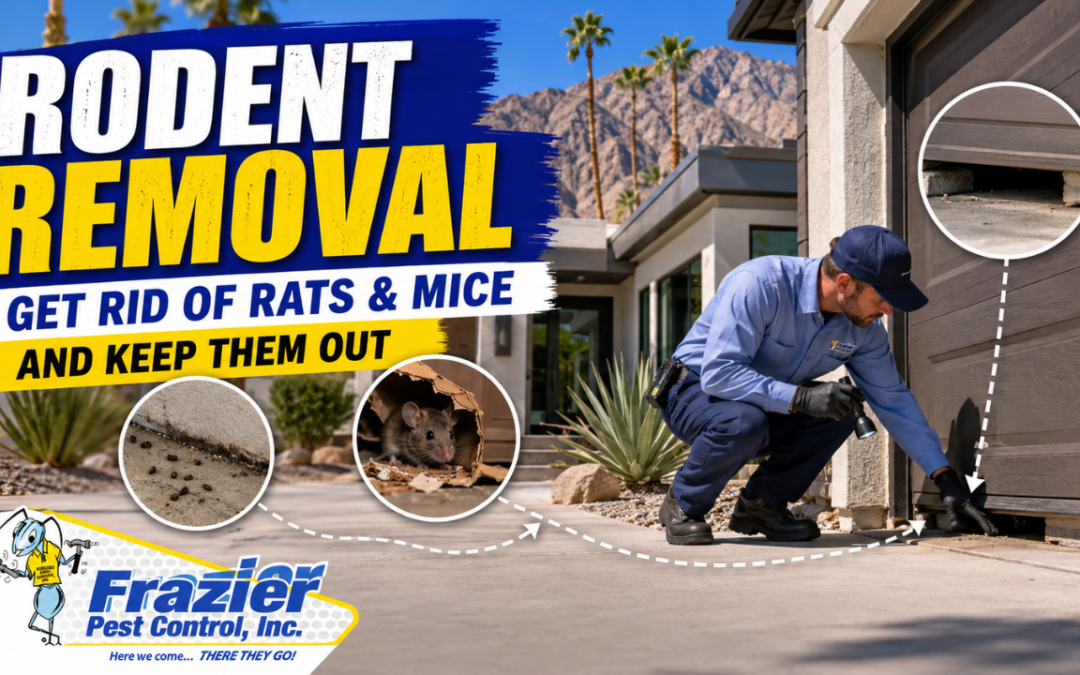
Rodent removal in Palm Springs should begin as soon as you notice scratching sounds, droppings, gnaw marks, unusual odors, or signs of nesting. Rats and mice can enter desert homes through very small gaps and quickly settle into garages, attics, walls, and storage areas where food, water, and shelter are available.
If you’re searching for rodent removal in Palm Springs, chances are you’ve already noticed the telltale signs: scratching in the attic, droppings in the garage, a strange odor near a wall, or a late-night glimpse of a mouse darting behind storage boxes. In desert communities, rodents don’t need much to move in—just a small gap, a steady water source, and a safe place to nest.
At Frazier Pest Control, we help homeowners, businesses, and property decision-makers across Palm Springs, Palm Desert, Rancho Mirage, Desert Hot Springs, Indian Wells, Cathedral City, La Quinta, Indio, and Coachella address rodent activity with a plan that focuses on both removal and prevention. The goal isn’t just to catch what you see—it’s to reduce the chances you’ll be dealing with the same problem again in a few weeks.
For available treatment options, review our rodent removal service for rats, mice, gophers, and other rodent activity throughout the Coachella Valley.
Below is a practical, step-by-step guide to what rodent problems look like in the Coachella Valley, why quick fixes often fall short, and what to expect from a professional approach.
Rodent Removal in Palm Springs: Signs You May Have a Problem
1) How to tell you have a rodent problem (and why it escalates fast)
Rodents are good at staying out of sight. By the time you see one, there may already be ongoing activity. Common signs include:
- • Droppings: Often found along walls, behind appliances, in cabinets, in garages, or near stored items. (If you’re unsure, avoid sweeping dry droppings—ask about safe cleanup steps.)
- • Noises: Scratching, scurrying, or gnawing sounds in attics, walls, or ceilings—especially after dark—may indicate rodents moving, nesting, or damaging materials inside hidden areas.• Gnaw marks: Chewed cardboard, plastic bins, wiring, or wood edges.
• Rub marks and “runways”: Dark smudges along baseboards or edges where rodents repeatedly travel.
• Nesting material: Shredded paper, insulation disturbance, or fabric pulled into hidden areas.
• Odors: A persistent musky smell can indicate nesting or a heavier level of activity.
Different pests can leave similar evidence. If you are uncertain about what you found, compare the most common signs of a rodent infestation in Coachella Valley homes before deciding what to do next.
Why it can escalate quickly: Rodents reproduce, establish regular travel routes, and take advantage of consistent food and water sources. In neighborhoods across Palm Desert and Rancho Mirage, activity can increase when outdoor conditions push rodents toward shelter or when landscaping and storage areas provide cover.
Why DIY Traps Often Fail to Solve Rodent Problems
DIY can help confirm activity, but it often misses the bigger picture—especially if the issue is more than a single mouse.
Common reasons DIY efforts stall out:
- • The entry point is still open. If rodents can get in, new ones can replace the ones you trap.
• The “hot spots” aren’t identified. Rodents follow edges and hidden routes; random trap placement often underperforms.
• Food and water sources remain available. Pet food, bird seed, unsealed pantry items, garage snacks, and irrigation leaks can keep activity going. - The species and behavior are not accounted for. Roof rats and house mice may use different entry points, nesting locations, and travel routes. Compare common rat infestation warning signs with the signs, risks, and removal considerations for mice in Coachella Valley homes.• The problem is in multiple zones. A home can have activity in the attic, garage, and yard at the same time.
Considering a plug-in repeller as an alternative to traps? Review whether ultrasonic pest control works before relying on a device instead of inspection, targeted removal, and exclusion.
If you’re in Cathedral City or Indio and you’ve been trapping for days with inconsistent results, that is usually a sign the issue needs a broader plan involving inspection, targeted removal, entry-point correction, and follow-up monitoring.
3) How professional rodent removal works: inspection, removal, and follow-up
Every property is different, but a professional rodent removal process typically follows a clear sequence. Here’s what you can expect when you work with a local team like Frazier Pest Control.
Step 1: Inspection and problem mapping
The first goal is to confirm what’s happening and where. That includes:
• Identifying signs of activity (droppings, rub marks, gnawing, nesting)
• Locating likely travel routes (along walls, rafters, fence lines)
• Checking common access points (garage door corners, roofline gaps, vents)
• Noting attractants (food storage, clutter, water sources)
For businesses and HOAs, the inspection also considers shared walls, utility rooms, trash areas, and landscaping patterns that can affect multiple units.
Step 2: Targeted removal strategy
Removal methods depend on the situation and the property layout. The key is targeted placement and consistent monitoring rather than a one-size-fits-all approach.
 Step 3: Follow-up and adjustment
Rodent work often requires follow-up because:
• Activity patterns change once pressure is applied
• New evidence may reveal additional entry points
• Some areas need re-checking after initial reduction
A good plan is measured by results and reduced signs over time—not just “we set traps and left.”
Step 4: Prevention recommendations (the part that reduces repeat calls)
This is where long-term value comes from. Prevention focuses on reducing access and reducing attractants so the property is less inviting.
Frazier Pest Control is family-owned and locally operated, and our approach is built around both treatment and prevention—important in desert communities where pest pressure can be persistent.
4) Common entry points in desert homes and buildings (and what exclusion means)
Rodents don’t need an open door. Small gaps and overlooked transitions are enough.
Common Rodent Entry Points in Coachella Valley Homes
• Garage door corners and worn weather stripping
• Gaps around pipes and utility lines (laundry rooms, water heaters)
• Roofline and eave gaps
• Attic and roof vents that aren’t properly screened
• Cracks and gaps where stucco meets other materials
• Side gates, fence lines, and overgrown landscaping that create “highways” to the roof
• Storage clutter that provides hiding places (especially in garages)
What “exclusion” means: Rodent exclusion involves identifying and addressing openings that rats and mice may use to enter a building. A practical rodent exclusion strategy can help reduce repeat entry when it is combined with removal, attractant correction, and follow-up monitoring.
 Even if you’re primarily dealing with a problem inside, the outside environment matters. If roof rats can travel from trees to rooflines, or if rodents can hide behind dense landscaping, activity can persist.
If the activity appears to be above the ceiling, learn how rats enter rafters and attics in desert homes. Around the exterior, these pest-control landscaping tips can help reduce vegetation, debris, moisture, and access routes that may support rodent activity.
5) How long rodent removal takes in the Coachella Valley—and what affects the timeline
One of the most common questions we hear is: “How long will this take?” The honest answer is that it depends on the level of activity and how accessible the problem areas are.
Factors that can shorten the timeline:
• Early detection (first signs vs. long-term nesting)
• Clear access to attic/garage/crawl areas
• Quick changes to attractants (sealing food, reducing clutter)
Factors that can extend the timeline:
• Multiple entry points
• Heavy activity in attics or wall voids
• Nearby environmental pressure (dense landscaping, shared walls, frequent trash exposure)
• Properties with multiple buildings or units (common for HOAs and commercial sites)
In Palm Desert and Indian Wells, for example, seasonal occupancy can also play a role: a home that sits quiet for stretches can develop unnoticed activity, and the first visit may uncover multiple zones that need attention.
A professional inspection is the first step toward effective rodent removal in Palm Springs, because it identifies active areas, likely travel routes, attractants, and the openings rodents may be using.
The best way to get a realistic timeline is a professional inspection and a clear plan for follow-up.
6) What you can do today to reduce activity before your appointment
If you’re waiting for service, these steps can help reduce activity and make professional work more effective:
• Seal food tightly: Move pantry items into hard containers; don’t leave pet food out overnight.
• Reduce water sources: Fix drips, check irrigation leaks, and avoid leaving standing water.
• Declutter key areas: Especially garages, storage rooms, and areas along walls where rodents travel.
• Trim back contact points: If branches touch the roofline, trim them back to reduce access routes.
• Secure trash: Use tight-fitting lids and keep bins clean.
• Avoid handling droppings unsafely: If you need to clean, ask for guidance on safe steps and protective measures.
If you’ve had repeated sightings in the same area (kitchen, garage, attic access), note the location and timing—those details help pinpoint travel routes.
Why local experience matters
Rodent issues in desert communities can be persistent because conditions outside can change quickly, and properties often have features that create easy access—rooflines, garages, landscaping, and storage areas. Working with a local company that understands the patterns across Palm Springs, Desert Hot Springs, and Indio can make the process more efficient.
Frazier Pest Control is licensed, bonded, and insured (as stated in our packet), offers free quotes, and brings 37+ years of experience to residential, commercial, and HOA pest control. If you’re dealing with rats or mice, the most cost-effective path is usually a plan that combines removal with prevention so you’re not paying to solve the same problem repeatedly.
Request a Rodent Inspection
Have you noticed scratching sounds, droppings, gnaw marks, nesting
material, unusual odors, or repeated rodent sightings? An inspection
can help identify active areas, travel routes, attractants, and possible
entry points.
Serving Palm Springs and communities throughout the Coachella Valley.
Recent Comments