
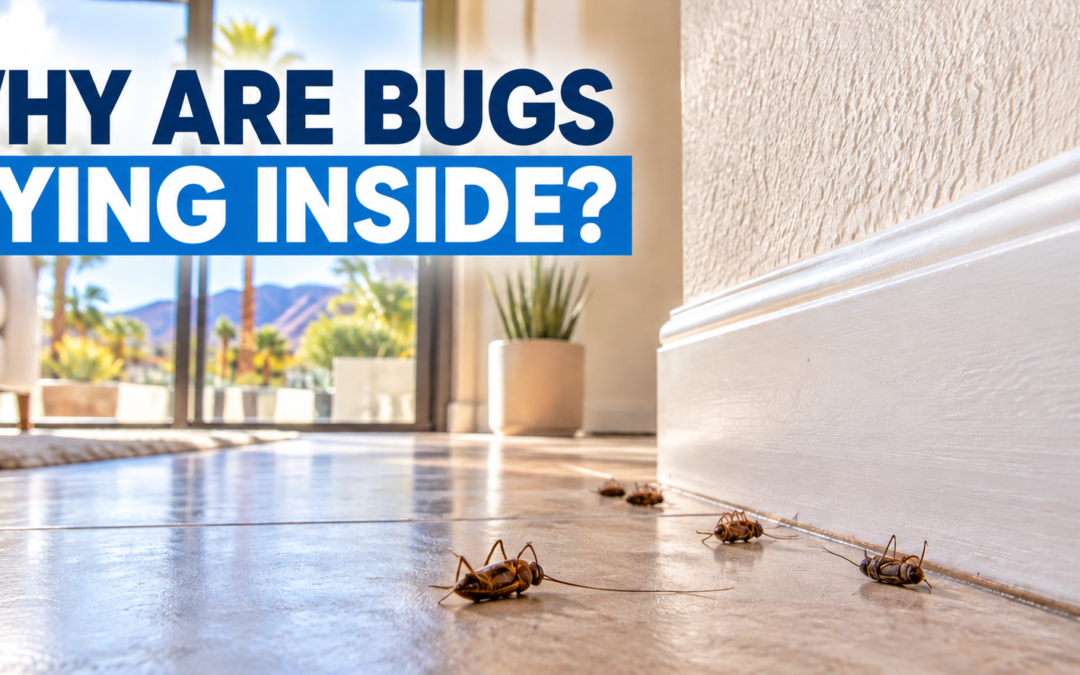
If you keep finding dead bugs in your Palm Springs home, it usually means one of three things is happening: (1) insects are still getting in (even if they’re dying after), (2) you’re seeing the “after-effect” of a recent treatment or seasonal shift, or (3) there’s a hidden source (moisture, food, or harborage) that’s supporting activity you’re not seeing yet. The key buyer question is simple: are dead bugs a sign the problem is getting better—or a sign you still have an entry or nesting issue?
Below is a practical way to interpret what you’re seeing and decide what to do next, based on patterns that show up in desert-area homes from Palm Springs through the Coachella Valley.
1) The direct answer: what “dead bugs inside” usually indicates
Finding dead insects indoors is not automatically “good news.” It can indicate control measures are working, but it can also indicate ongoing entry.
Here’s the simplest way to think about it:
– A few dead bugs near a single doorway, window, or garage threshold often points to an entry point. They get in, then dehydrate, get trapped, or die from residual products (if any were used).
– Dead bugs appearing in multiple rooms, especially along baseboards, can suggest broader indoor movement (or multiple entry points).
– Dead bugs repeatedly showing up in bathrooms, laundry rooms, or under sinks can point to moisture or plumbing-related conditions that attract insects (even in a dry climate).
What matters most is the pattern: what type of bug, where it’s found, and whether the number is trending up or down over 1–2 weeks.
2) Most common causes in desert homes (and how to tell which one you have)
A) You have an entry point (and the bugs are dying after they get in)
In the Coachella Valley, small gaps can be enough. Common “quiet” entry points include:
– Door sweeps that don’t fully contact the threshold
– Garage door corners and side seals
– Window weep holes and worn weatherstripping
– Pipe penetrations under sinks or behind toilets
– Gaps where stucco meets trim or where utilities enter
How to tell: you’ll often find bugs concentrated near one side of the home, near exterior doors, or in the garage and adjacent rooms. You may also notice more activity after windy days or temperature swings.
What to do: focus on exclusion first (sealing and tightening). If you only treat without sealing, you can keep seeing “new” dead bugs because the entry stays open.
B) You recently had a treatment (and you’re seeing the “flush-out” period)
After a professional treatment, it’s common to see increased visible activity for a short period, including dead insects. That doesn’t necessarily mean the treatment failed; it can be part of the process as insects contact treated areas.
How to tell: the timing lines up. You didn’t see much before, then you treated, and now you’re seeing dead bugs along edges, in corners, or near likely travel routes.
What to do: don’t immediately switch products or over-apply sprays. Track what you see for 7–14 days, note locations, and report the pattern to your pest company so they can adjust the plan if needed.
C) The bugs are coming from a moisture pocket (even in a dry climate)
“Desert dry” doesn’t mean “no moisture.” Bathrooms, laundry rooms, HVAC condensate lines, and under-sink plumbing can create micro-environments that attract insects.
How to tell: you find insects (dead or alive) repeatedly in the same moisture-adjacent spots: under a vanity, behind a toilet, near a shower, around a floor drain, or near a laundry standpipe.
What to do: fix the moisture driver first. Pest control can help reduce the population, but if a slow leak, damp cabinet base, or drain issue remains, you may keep seeing insects.
D) You’re seeing scavengers feeding on something you can’t see
Sometimes the “dead bugs” you notice are only part of the story. Scavenger insects can show up when there’s a food source: pet food storage, pantry spills, grease residue, or even dead insects accumulating in a light fixture or window track.
How to tell: you see repeated activity near a pantry, trash area, pet feeding station, or a specific light source at night.
What to do: deep-clean the specific area, store dry goods in sealed containers, and reduce attractants. If the pattern continues, a targeted inspection helps identify what’s sustaining the activity.
E) Seasonal pressure and outdoor conditions are pushing insects inward
In desert communities, shifts in heat, wind, and outdoor watering patterns can change where insects forage. Even without making any changes inside, you can suddenly notice more insects at doors, garages, and patios.
How to tell: you see the issue cluster around exterior-facing rooms, patio sliders, or the garage, and it seems to coincide with noticeable weather changes.
What to do: reduce exterior attractants (debris, clutter against the house, standing water), tighten up exclusion, and consider a perimeter-focused plan.
3) What to do this week: a practical homeowner checklist
If you want a clear next step without guessing, use this checklist. The goal is to collect enough information to either solve it yourself (when it’s minor) or give a pest professional the details they need to be efficient.
Step 1: Identify the insect (even roughly)
You don’t need perfect identification, but you do need a category. Take a clear photo next to a coin for scale. Different insects point to different sources and entry behaviors.
Step 2: Map the “where”
Write down:
– Room
– Exact spot (baseboard, windowsill, tub edge, under sink, garage corner)
– Time of day you noticed it
A simple pattern (same wall, same doorway, same bathroom) is often the clue.
Step 3: Check the easiest entry points first
In 10 minutes, you can check:
– Door sweep contact (front door, back door, garage-to-house door)
– Sliding door gaps
– Garage door bottom seal
– Torn screens
– Gaps around plumbing under sinks
If you can see light, feel airflow, or slide a credit card through a gap, insects can often use it.
Step 4: Remove attractants for 72 hours
– Store pet food in sealed containers
– Wipe counters and baseboards where crumbs/grease collect
– Empty trash nightly
– Reduce cardboard clutter in garages and closets
This doesn’t “fix” every pest issue, but it quickly tells you whether food/harborage is a major driver.
Step 5: Don’t mix multiple DIY chemicals
If you’ve already sprayed something, avoid stacking products. Over-application can create indoor air concerns and can complicate diagnosis. If you’re unsure what was used or where, pause and document before doing more.
4) When it’s time to call a pro (and what to ask on the phone)
Call a pest control company when:
– You’re seeing the same bug repeatedly in the same area for more than 1–2 weeks
– The number of insects is increasing
– You’re seeing activity in multiple rooms (suggesting multiple entry points or a broader issue)
– You suspect a hidden moisture problem or you can’t locate the source
– You’re dealing with stinging/biting pests or you have household health sensitivities and want a controlled plan
Questions to ask (so you get a plan, not just a spray):
– “Can you inspect for entry points and tell me where they’re getting in?”
– “Do you recommend exclusion work (door sweeps, sealing gaps), and what should I prioritize first?”
– “If I keep seeing dead bugs after treatment, what’s the normal window before we reassess?”
– “What should I do inside the home to reduce attractants while you handle the exterior/perimeter?”
A good outcome is clarity: what the insect is, why it’s there, where it’s entering, and what changes will reduce repeat sightings.
5) How to reduce repeat issues long-term in the Coachella Valley
Long-term control in desert cities is usually a combination of exclusion, moisture management, and consistent monitoring.
– Tighten the building envelope: door sweeps, weatherstripping, sealing around penetrations, and keeping screens intact.
– Keep the garage “unfriendly”: reduce cardboard, store items in sealed bins, and keep the perimeter of the garage door well-sealed.
– Manage moisture: fix slow leaks, keep under-sink areas dry, and address drain or condensate issues promptly.
– Reduce exterior harborage: keep vegetation and stored items from touching the structure, and avoid letting debris build up along the foundation line.
If you’re a seasonal resident or you leave the home vacant, these steps matter even more because small issues can grow quietly.
If you want help identifying what’s actually driving the dead-bug sightings (entry point vs. moisture vs. post-treatment flush-out), Frazier Pest Control can inspect and recommend a targeted plan based on what you’re seeing and where you’re seeing it.
The fastest way to get to a solution is to share: a photo, the rooms involved, and whether the issue is new, seasonal, or ongoing. That information turns “we keep finding dead bugs” into a fixable, specific next step.
Want a clear answer on why you’re finding dead bugs—and what to do next? Contact Frazier Pest Control to schedule an inspection and get a targeted plan for your home.
Recent Comments