
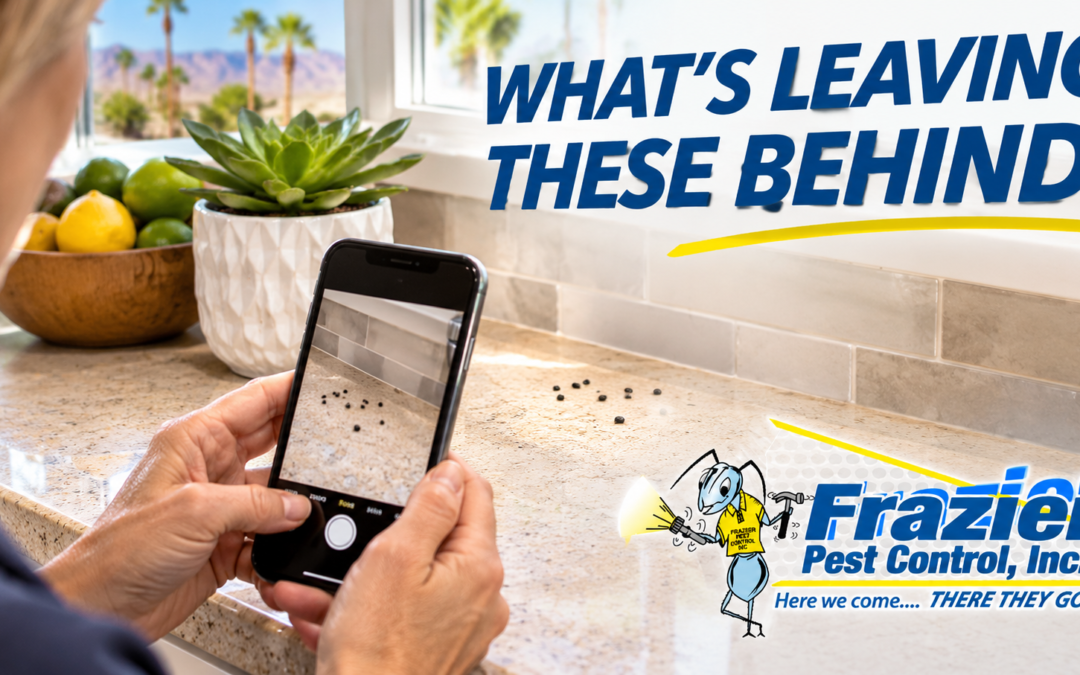
If you’re finding tiny black droppings in your kitchen in Palm Springs, the question is usually: “Is this roaches, mice/rats, or something else—and what should I do first?” The quickest path is to identify the droppings by size, shape, and where they’re showing up, then look for one or two confirming clues. Correct ID matters because the fix for roaches (sanitation + targeted treatment + harborage reduction) is different from rodents (exclusion + trapping + sanitation), and doing the wrong thing can waste time or even make the problem harder to solve.
Below is a practical decision guide you can use in 10–15 minutes, using only what you can safely observe.
1) The fast answer: what tiny black droppings usually mean (and why ID matters)
Tiny black droppings in a kitchen most often point to one of these categories:
– Cockroaches (often “pepper-like” specks or small cylinders, commonly in hidden, warm, or damp areas)
– Mice (small, rice-shaped pellets, often along edges, inside cabinets, or near food storage)
– Rats (larger pellets; if you’re calling them “tiny,” rats are less likely—but not impossible if you’re seeing juvenile activity or only a few pieces)
– Lizards/geckos (often a dark pellet with a white tip; commonly near doors, windows, garages, or patios that connect to the kitchen)
Why it matters: each pest has a different “root cause.” Roaches are often about access to water/food/harborage and can persist even in clean homes if they have a moisture source. Rodents are often about entry points and shelter pathways. Lizards are usually a sign of insects around the home and easy access points (and the droppings can be mistaken for rodents).
2) Step 1: Use size, shape, and placement to narrow the pest
Use the three checks below in order. You don’t need perfect certainty—just enough to choose the right next step.
A) Size check (quick sorting)
– Very small specks, like ground pepper or coffee grounds: more consistent with cockroaches.
– Small pellets about the size of a grain of rice: more consistent with mice.
– Larger pellets (closer to a raisin or larger): more consistent with rats.
– Small pellet with a distinct white/chalky tip: often lizard/gecko.
If you’re not sure, take a clear photo next to a common object for scale (a coin works well). Scale is one of the fastest ways for a pest professional to narrow it down.
B) Shape check (what the ends look like)
– Mouse droppings are usually pointed at the ends.
– Rat droppings are often more blunt (though this can vary).
– Roach droppings can look like tiny cylinders or ridged grains, but in light infestations they may look like scattered specks.
– Lizard droppings often look like a dark pellet plus a white cap.
C) Placement check (where you’re finding them)
Ask: “Where exactly are they accumulating?”
More consistent with cockroaches:
– Under the sink, near plumbing penetrations, or around the cabinet base
– Behind/under the refrigerator, dishwasher, or stove
– Inside cabinet corners where crumbs and moisture collect
– Along the back edge of countertops where appliances sit
More consistent with mice:
– Inside lower cabinets and pantry corners
– Along walls/edges (rodents tend to travel edges)
– Near pet food storage, snack drawers, or bagged goods
– In seldom-disturbed areas like the back of a drawer or toe-kick voids
More consistent with lizards/geckos:
– Near sliding doors, windowsills, or thresholds
– In garages that connect to the kitchen, or near an interior door that stays cracked
– Along baseboards near exterior walls
3) Step 2: Confirm with nearby clues (without turning it into a science project)
Once you have a leading suspect, confirm with one or two additional signs. This prevents you from treating for roaches when it’s actually mice, or sealing for rodents when it’s actually lizards.
If you suspect cockroaches, look for:
– Smear marks or “pepper” specks in cabinet hinges/corners
– Egg cases (small, brownish capsules) tucked into cracks
– Activity at night: roaches are more visible after dark when lights are off
– Moisture sources: slow leaks under the sink, condensation, or a damp sponge left overnight
If you suspect mice, look for:
– Gnaw marks on packaged foods, especially in pantries
– Shredded paper/insulation in a cabinet void or behind appliances
– Rub marks/grease along baseboards or cabinet edges
– Sounds at night in walls or toe-kicks
If you suspect rats, look for:
– Larger droppings and stronger odor in a localized area
– Evidence around exterior entry points (gaps at garage corners, roofline transitions, or utility penetrations)
If you suspect lizards/geckos, look for:
– Droppings clustered near windows/doors
– Insect activity around exterior lights or entryways (lizards follow food)
– A visible lizard in the garage/patio area at dusk or night
Important: you don’t need to handle droppings to identify them. Visual inspection and photos are usually enough to make a good call.
4) Step 3: What to do right now (cleaning, containment, and what not to spray)
Regardless of the pest, your immediate goals are (1) reduce exposure, (2) preserve clues for accurate diagnosis, and (3) avoid actions that scatter the problem.
A) Safe cleanup basics (general guidance)
– Ventilate the area.
– Avoid sweeping or vacuuming dry droppings aggressively if you suspect rodents; that can aerosolize particles. Instead, use a damp method (for example, lightly wetting the area and wiping with disposable towels) and dispose of waste in a sealed bag.
– Wash hands thoroughly afterward.
B) Containment steps that help for most pests
– Remove accessible food sources: store pantry items in sealed containers, and keep pet food sealed.
– Reduce water access overnight: fix obvious drips, don’t leave standing water in sinks, and wring out sponges.
– Declutter under-sink and pantry areas so you can see what’s happening.
C) What not to do (common mistakes)
– Don’t “fog” or bomb the kitchen for roaches. This can push roaches deeper into walls and voids and may not address the source.
– Don’t place random poison bait for rodents without a plan. Misplaced bait can create odor issues if rodents die in inaccessible areas, and it doesn’t solve entry points.
– Don’t seal openings until you’re confident about rodent pathways and you’ve set a capture plan. Sealing without addressing active rodents can trap them inside.
D) Targeted next steps by likely pest
If it looks like cockroaches:
– Focus on sanitation and moisture control first (especially under sinks and behind appliances).
– Note where you see droppings most; that’s often near harborage.
– Avoid over-the-counter sprays in cracks/voids that can repel roaches into harder-to-treat areas.
If it looks like mice:
– Identify likely entry points: gaps under doors, around plumbing lines under the sink, and openings where cabinets meet walls/floors.
– Consider snap traps placed along edges where activity is seen (not in the open middle of the room). If you’re unsure, pause and call a professional so placement is safe and effective.
If it looks like lizards/geckos:
– Reduce insect attraction near doors/windows (for example, manage exterior lighting and keep door sweeps intact).
– Check weatherstripping and door thresholds.
– Remember: lizard droppings can mimic rodent droppings, so the white tip is a key clue.
5) When to call Frazier Pest Control (and what to have ready for a faster diagnosis)
Call for professional help when any of the following is true:
– You’re seeing droppings repeatedly (daily or every few days), even after cleaning.
– Droppings are inside food storage areas, drawers, or on counters.
– You can’t confidently tell whether it’s roaches or rodents.
– You suspect a rodent issue and want an exclusion-first plan (not just “set traps and hope”).
– You’ve used sprays or store-bought products, and the signs keep returning.
To speed up diagnosis, have these ready:
– 2–3 photos of the droppings with a size reference (coin) and a wider shot showing where they were found.
– Notes on location(s): under sink, pantry shelf, behind fridge, near sliding door, etc.
– Timing: when you first noticed it and whether it’s increasing.
– Any other signs: live sightings, gnawing, odors, moisture leaks.
For homes across the Coachella Valley, accurate identification plus a targeted plan is what prevents the cycle of “clean, spray, repeat.” If you’re in Palm Springs, Palm Desert, Rancho Mirage, Desert Hot Springs, Indian Wells, Cathedral City, La Quinta, Indio, or Coachella and want help identifying what’s leaving the droppings—and stopping it at the source—Frazier Pest Control can help you decide the next best step based on what you’re seeing.
Recent Comments