
If you live in the Coachella Valley, you already know the drill: the nights are warm, the landscaping is desert-friendly, and sooner or later someone spots a scorpion where it absolutely shouldn’t be—inside.
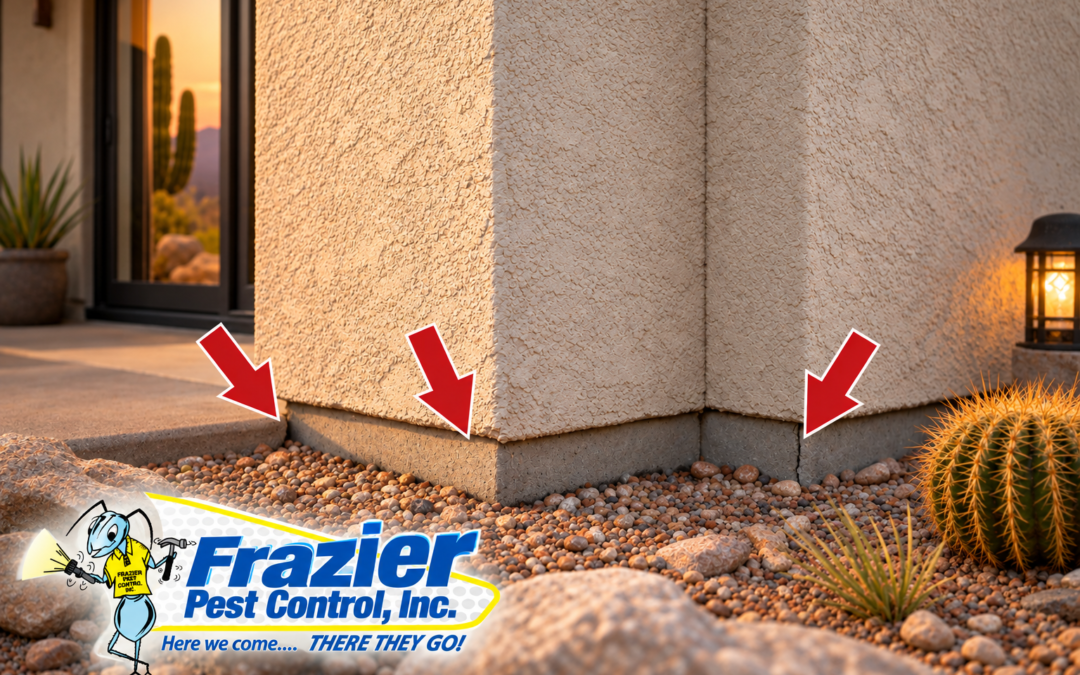
One of the most overlooked entry points we see in Palm Springs, Palm Desert, Rancho Mirage, and nearby cities is the weep screed area at the base of stucco walls. Homeowners often focus on doors, windows, and garage seals (all important), but miss the small gaps and transitions where stucco meets the foundation. Those gaps can be just big enough for bark scorpions to slip through.
Below is a practical, problem-solution guide to help you identify whether weep screed scorpion entry is likely at your home, what you can do to reduce the risk, and when it’s time to bring in a professional.
For a broader look at entry points, hiding areas, moisture conditions, prey insects, and prevention, review these scorpion-prevention strategies for Coachella Valley homes.
The problem: why weep screed gaps are a scorpion “on-ramp”
A weep screed is a metal (or sometimes plastic) strip installed at the bottom edge of stucco. Its job is to let moisture drain out of the wall system and to create a clean termination point for stucco. In a perfect world, it’s installed correctly, the grade is right, and the transitions are tight.
In the real world—especially in older desert homes or homes that have had landscaping changes—three things commonly happen:
• Tiny openings form at corners, seams, and transitions. These can be from settling, stucco cracking, or slight separation where materials meet.
• Soil, mulch, gravel, or decorative rock gets built up too high against the wall. That can hide openings and create a protected travel lane for pests.
• Irrigation overspray or occasional monsoon moisture changes the micro-environment at the base of the wall, attracting insects. Where insects go, scorpions follow.
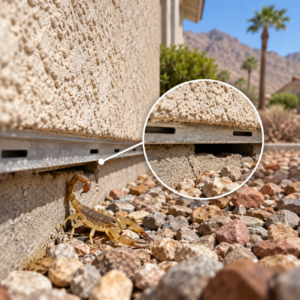
Bark scorpions don’t need a big hole. They’re excellent at squeezing into narrow spaces, and they prefer protected, tight areas. The weep screed zone provides exactly that: shade, cover, and a direct line to wall voids and interior penetrations.
Not every scorpion found around a Coachella Valley home is an Arizona bark scorpion. Review this Arizona bark scorpion identification and safety guide before assuming the species, and avoid handling an unidentified scorpion directly.
How to tell if scorpions are likely entering at the weep screed
You don’t need to guess. A few checks can help you narrow it down.
A. Where are you finding them?
• Near baseboards on exterior walls (especially living rooms, bedrooms, or bathrooms that share an exterior wall)
• In ground-floor bathrooms or laundry rooms along an outside wall
• In garages along the wall that faces the yard
If sightings cluster along exterior walls rather than the center of the home, exterior entry points become more likely.
Repeated activity in one bathroom, bedroom, laundry room, or garage can also point to a nearby gap or moisture source. Learn why pests repeatedly appear in one room and what that pattern may reveal about the entry location.
B. Look for “protected pathways” outside
Walk the perimeter at dusk with a flashlight and look at the base of the stucco:
• Is the decorative rock or soil level close to, or above, the weep screed line?
• Are there planters, stacked stone, wood piles, or stored items touching the wall?
• Are there cracks where the slab meets the wall, or where a patio meets the stucco?
Scorpions often travel along edges. If your wall base is cluttered or the grade is high, you’re giving them cover.
C. Check weep screed corners and seams
Pay special attention to:
• Outside corners of the home
• Where stucco meets a garage stem wall
• Where the wall meets steps, patios, or walkways
• Hose bibs, AC line sets, and other penetrations near the base of the wall
Even if the weep screed itself is doing its job, small separations around it can be enough for entry.
The wall base is only one part of the inspection. Use this guide to find hidden pest entry points around Coachella Valley homes, including foundation cracks, utility penetrations, garage seals, AC lines, and door-frame gaps.
D. Night inspection (carefully)
If you’re comfortable doing so, a UV flashlight can help locate scorpions at night. If you repeatedly see scorpions cruising the foundation line or hanging around the base of stucco walls, that’s a strong sign the perimeter is the pressure point.
Safety note: If you do night checks, wear closed-toe shoes and avoid reaching into landscaping or rock beds.
The solution: exclusion that blocks scorpions without trapping moisture
This is the part where people accidentally create new problems. The weep screed exists for drainage. Sealing everything indiscriminately can trap moisture in the wall system, which is not what you want.
The goal is targeted exclusion: close the gaps that allow pest entry while keeping the wall’s drainage function intact.
 A. Correct the grade and clear the inspection zone
Before you seal anything, make sure you can actually see what you’re working with.
• Pull back decorative rock or soil so the weep screed is visible.
• Aim for a clear “inspection strip” along the base of the wall.
• Avoid piling mulch or soil against stucco.
In many Coachella Valley yards, rock beds are installed for low maintenance, but they can be pushed right up to the wall. That looks clean, but it can hide cracks and create a shaded travel lane.
B. Seal cracks and transitions adjacent to the weep screed
Common targets:
• Cracks where the slab meets the stem wall
• Gaps at corners where materials meet
• Openings around pipe penetrations near the base of the wall
Use appropriate exterior-grade sealants for the material and location. The key is to seal the “side gaps” and transitions, not to block the weep screed’s intended drainage openings.
C. Address door thresholds and garage edges nearby
Scorpions often exploit multiple small entry points. If you’re already working the perimeter, check:
• Weatherstripping on exterior doors
• Door sweeps (especially if you can see light under the door)
• Garage door bottom seal and side seals
• The gap at the garage slab edge where it meets the wall
Many “weep screed entry” cases are actually a combination: scorpions pressure the foundation line, then take the easiest available gap—sometimes the garage, sometimes a door threshold, sometimes a wall transition.
If daylight is visible around an exterior door or garage-to-house door, use this door-gap inspection and sealing checklist to evaluate door sweeps, thresholds, weatherstripping, frames, and nearby utility gaps.
D. Reduce harborage right at the wall
At the base of the wall, remove or relocate:
• Stacked firewood
• Spare pavers or tile
• Pots stored against the stucco
• Dense groundcover touching the wall
Scorpions like tight, undisturbed spaces. If you remove the hiding spots, you reduce the number of scorpions that linger long enough to find an entry point.
Exterior conditions can determine how much pest activity reaches the foundation. These pest-control landscaping tips for Coachella Valley yards explain how vegetation, irrigation, debris, stored materials, and soil contact can support pests near the structure.
Lower the scorpion “food supply” and pressure around the foundation
Even perfect sealing won’t feel successful if the yard is producing a steady stream of insects and scorpions.
A. Control the insects that scorpions hunt
Bark scorpions feed on insects like crickets, roaches, and other small bugs. If you’re seeing lots of crickets at night around the foundation, that’s a major driver.
Practical steps:
• Reduce exterior lighting that attracts insects, or switch to less-attractive bulbs where possible.
• Fix irrigation overspray that keeps areas damp.
• Keep trash areas clean and lids tight.
Rain, irrigation, and sudden moisture changes can also increase insect movement around walls and foundations. Learn why pest activity increases after rain and how wet conditions can expose existing entry points.
B. Be strategic with landscaping
In desert cities like Palm Springs and La Quinta, landscaping is often rock-based with drought-tolerant plants. That’s fine, but watch for:
• Dense plantings that create shaded, humid pockets
• Palm fronds or debris piled near the wall
• Unmaintained block walls or fence lines with clutter
C. Pay attention to block walls and neighboring pressure
Scorpions can travel along block walls and move between properties. If your home backs to a wash, open desert, or an unmaintained lot (common in parts of Desert Hot Springs, Indio, and Coachella), perimeter pressure can be higher.
That doesn’t mean you can’t control it—it just means exclusion plus ongoing perimeter control becomes more important.
When to call Frazier Pest Control (and what a professional approach looks like)
If you’ve had more than one indoor scorpion sighting, or if you’re seeing scorpions regularly along the foundation at night, it’s time for a structured plan.
A professional scorpion control approach should include:
A. A targeted exterior inspection
We look at the exact areas scorpions use:
• Weep screed transitions and visible gaps
• Slab-to-wall cracks
• Door thresholds, garage seals, and utility penetrations
• Landscaping conditions that create harborage
B. A perimeter-focused treatment plan
Because scorpions are primarily an exterior problem that becomes an interior problem, the perimeter is the priority. The goal is to reduce activity where they travel and hunt.
C. Guidance on exclusion priorities
Not every gap matters equally. We help you prioritize the spots that are most likely to be active entry points, especially around the base of stucco and other low-level transitions.
D. Ongoing prevention
In the Coachella Valley, pest pressure isn’t a one-time event. Heat, seasonal insect cycles, irrigation patterns, and monsoon activity can all change what’s happening around your foundation. A consistent plan helps prevent the “we sealed it, and they came back” cycle.
A final note on safety
If you have kids, pets, or frequent guests, indoor scorpion sightings are more than just unsettling—they’re a safety concern. Until you’ve reduced activity:
• Shake out shoes left on the floor
• Keep beds slightly away from walls and avoid bedding touching the floor
• Use caution when reaching into stored items in garages and closets
Homes with dogs or cats may need additional precautions around garages, landscaping, block walls, and stored items. Review these scorpion precautions for pets to reduce the risk of an unexpected encounter.
Request a Scorpion Inspection
Finding scorpions near the foundation or inside rooms that share an
exterior wall? An inspection can help identify active travel routes,
possible entry points, prey-insect activity, moisture conditions, and
landscaping features contributing to the problem.
Scorpion-control assistance for Palm Springs and communities throughout
the Coachella Valley.
Recent Comments