
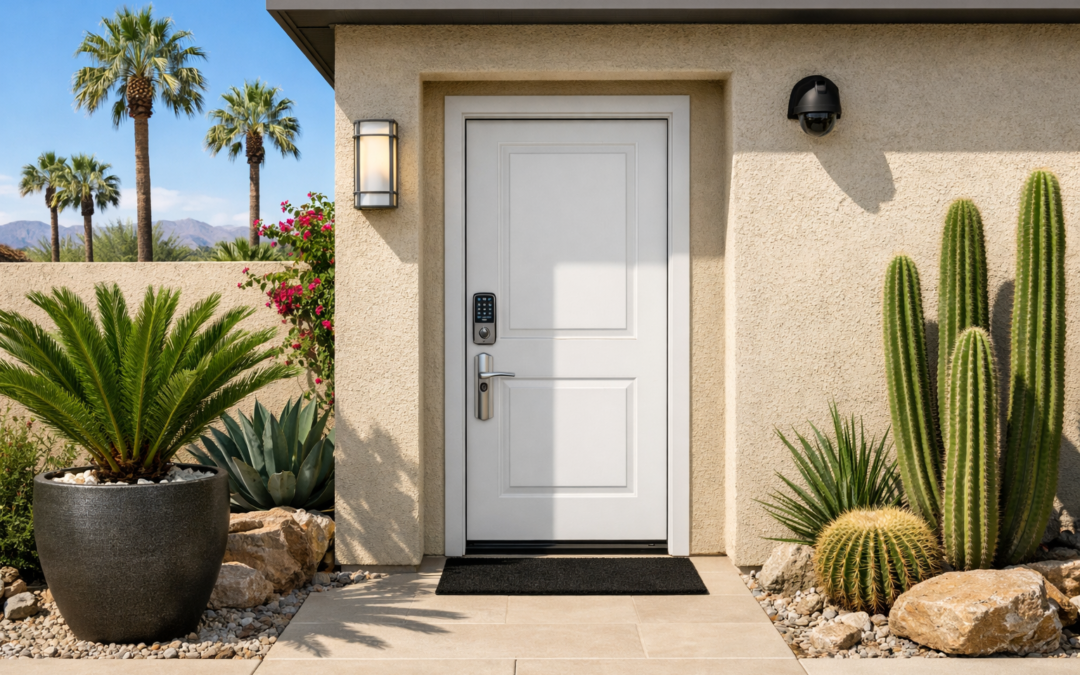
This guide is a timely, practical checklist you can use right now to stop crickets coming in through door gaps—without turning your home into a construction project. We’ll cover what to inspect, what to replace, what to seal, and how to make your entryways less attractive in the first place.
Crickets are only one of several common insects found in Palm Springs that may use gaps around doors, windows, utility lines, and garage openings to enter desert homes.
Crickets Coming In Through Door Gaps: Why It Happens
1) Why crickets show up now in the Coachella Valley (and why doors are the #1 entry point)
Crickets are outdoor insects. They don’t “want” to live in your house, but they do want three things your home can provide better than the yard:
• Cooler, more stable temperatures (especially during hot spells)
• Moisture (from bathrooms, laundry rooms, pet bowls, or condensation)
• Shelter from predators and wind
Rain, humidity, wind, and changing outdoor conditions can also disturb cricket hiding places and increase movement around buildings. Learn why homeowners sometimes notice increased insect activity after rain and which exterior openings pests may use.
In desert communities like Cathedral City, La Quinta, Indio, and Desert Hot Springs, exterior doors are often the easiest path inside because:
• Door sweeps wear down fast from heat, sun exposure, and frequent use.
• Thresholds can shift slightly over time, creating a thin daylight line.
• Weatherstripping compresses and cracks, especially on south- and west-facing doors.
• Garage-to-house doors are commonly undersealed.
A cricket doesn’t need much space. If you can see light under or around a door, you may have enough of a gap for crickets coming in through door gaps—especially at night when they’re active and drawn toward light.
2) The 10-minute inspection: where to look for door gaps crickets use
Do this inspection at dusk or after dark if possible. Crickets are more active then, and you’ll also see how your exterior lighting affects insect activity.
A. The “flashlight test” (fastest way to find the problem)
1) Turn off interior lights near the door.
2) Have someone stand outside with a flashlight and shine it around the door perimeter.
3) Stand inside and look for any light leaking in.
Wherever you see light, you have an entry point.
B. Check the bottom first (most common)
• Door sweep: Look for a sweep that’s cracked, missing sections, or no longer touching the threshold.
• Threshold: Look for a warped or loose threshold, or a gap where the threshold meets the floor.
• Uneven contact: Open and close the door slowly. If the sweep touches on one side but not the other, the door may be slightly out of alignment.
C. Check the latch side and hinge side
• Weatherstripping: If it’s flattened, brittle, or peeling away, it’s not sealing.
• Corner gaps: The top corners are common “micro-gaps,” especially if the door frame has shifted.
D. Don’t forget these two doors
• Garage-to-house door: This is a major pathway for pests. Garages attract insects (and the insects attract other pests), and the interior door is often undersealed.
• Sliding doors: The track area can collect debris and prevent a tight seal. Even small track gaps can allow insects in.
E. Look for “indirect” routes
Sometimes the door itself is fine, but crickets are entering near the door:
• Gaps where stucco meets the door frame
• Utility penetrations near the entry (cable, irrigation control wiring)
• Cracks in the slab or expansion joints near the threshold
If you’re trying to solve crickets coming in through door gaps, the goal is to identify the exact entry points—not just spray and hope.
The door may not be the only access route. Use this guide to inspect other hidden pest entry points around Coachella Valley homes, including foundation cracks, utility penetrations, garage openings, window tracks, and gaps around air-conditioning lines.
3) DIY sealing fixes that actually work (sweeps, thresholds, weatherstripping, caulk)
Once you’ve found the gaps, focus on durable fixes. In desert heat, cheap materials fail quickly.
A. Replace the door sweep (often the single best fix)
What to look for:
• A sweep that makes full contact across the entire threshold
• A material that can handle heat and sun exposure
• A snug fit without dragging so hard it tears
Installation tips:
• Measure the door width accurately.
• Clean the bottom edge of the door before installing.
• After installation, re-do the flashlight test.
If you’re in Palm Springs or Palm Desert and your sweep is visibly worn, replacing it is usually more effective than spraying around the door.
B. Upgrade or adjust the threshold
If the threshold is loose or uneven:
• Tighten screws (if present) to raise the threshold slightly.
• Replace a warped threshold if it can’t be adjusted.
Important: Don’t raise it so high that the door doesn’t latch properly. A door that doesn’t latch creates a new gap on the latch side.
C. Replace weatherstripping around the frame
Weatherstripping should be resilient and springy. If it’s compressed flat, it won’t seal.
Focus areas:
• Latch side: common for small gaps
• Top corners: common for “daylight” leaks
After replacing, close the door on a strip of paper. If you can pull the paper out easily, the seal is still too loose.
D. Seal exterior cracks around the frame (the right way)
For small gaps between the exterior wall/stucco and the door frame:
• Use an exterior-grade sealant appropriate for your surface.
• Clean out dust and debris first.
• Apply a continuous bead—no “spot caulking.”
Avoid sealing areas that need to drain or breathe (for example, certain weep systems). If you’re not sure, it’s better to ask than to trap moisture.
E. Sliding door track maintenance
• Vacuum the track thoroughly.
• Clean sticky residue and sand.
• Check the brush seals and replace if worn.
A dirty track can prevent the door from closing tightly, leaving a long, thin gap that insects can exploit.
4) Reduce the “welcome mat”: lights, moisture, and landscaping near entries
Even with perfect seals, you’ll have fewer problems if you reduce what attracts crickets to your doors.
A. Exterior lighting: make it less attractive to insects
Crickets and many other insects are drawn to bright lights at night. If your porch light is on every evening, you’re concentrating insect activity right at your entry point.
Practical adjustments:
• Use motion sensors instead of leaving lights on all night.
• Consider warmer-toned bulbs that are less attractive to insects.
• Move bright lights away from the door if possible (lighting the walkway rather than the doorway).
B. Moisture control near entryways
Crickets are more likely to linger where there’s moisture.
Check:
• Leaky hose bibs/spigots near the front or back door
• Overwatering near the foundation
• Condensation lines from AC equipment draining near a doorway
• Pet water bowls near an exterior door
In the Coachella Valley, irrigation overspray is a common “insect magnet,” especially when it keeps soil damp near thresholds.
If crickets repeatedly appear near bathrooms, laundry rooms, plumbing, or air-conditioning equipment, check for moisture problems that attract indoor pests before relying on sealing or spraying alone.
C. Landscaping and clutter
 Crickets hide during the day. If you have harborage near doors, you’ll see more nighttime activity.
Reduce hiding spots:
• Keep planters and decorative items a bit away from door thresholds.
• Trim vegetation that touches the house.
• Remove leaf litter and debris near entries.
If you store items on the patio (cardboard, stacked pots, rolled-up mats), consider reorganizing. Clutter near doors gives crickets a staging area.
Conditions farther into the yard can also influence how many insects reach the structure. Follow these pest-control landscaping tips for Coachella Valley yards to reduce damp soil, vegetation contact, debris, and protected hiding places near exterior doors.
5) When sealing isn’t enough: signs you need professional cricket control
Sealing is the foundation. But if you’re still seeing crickets inside after you’ve addressed the obvious gaps, the issue may be bigger than one door sweep.
Here are signs it’s time to bring in a professional:
• You’ve sealed visible gaps, but crickets keep appearing in multiple rooms.
• You’re finding crickets in bathrooms or laundry rooms (moisture-driven activity).
• You suspect multiple entry points (doors, garage, sliding doors, wall penetrations).
• You’re also seeing other pests (ants, roaches, earwigs, spiders). Crickets can be part of a broader exterior activity pattern.
• You want a long-term plan rather than repeated indoor spraying.
Persistent cricket activity may indicate a broader exterior pest problem. Crickets are also a food source for scorpions, so reducing cricket activity, moisture, and sheltered hiding places may help reduce the conditions associated with scorpion activity around Coachella Valley homes.
A professional approach focuses on:
 • Identifying entry points you may not notice (including garage pathways and structural gaps)
• Targeting exterior harborages where crickets rest during the day
• Using a strategy that reduces activity around the home perimeter, so fewer insects reach your doors in the first place
When sealing, lighting changes, moisture correction, and habitat reduction do not resolve the problem, Frazier’s professional cricket and bug-control services can address exterior activity zones, potential harborages, and overlooked access routes.
If you’re dealing with crickets coming in through door gaps in Palm Springs, Rancho Mirage, Palm Desert, Indian Wells, Cathedral City, La Quinta, Indio, Coachella, or Desert Hot Springs, the fastest path to relief is usually: seal the gaps + reduce attraction + treat the exterior activity zones.
The good news: once the entry points are sealed correctly, many homeowners notice a dramatic drop in indoor sightings within days—because you’ve removed the easiest access route.
Request a Cricket Inspection
If crickets continue appearing after you replace worn seals, reduce exterior lighting, correct moisture, and remove nearby hiding places, there may be additional entry points or substantial exterior activity around the property.
Contact Frazier Pest Control or call (760) 328-6115 to request cricket-control service in Palm Springs or another Coachella Valley community.
Recent Comments