

If you’ve ever heard quick scratching above a bedroom ceiling at 2 a.m. in Palm Springs, you already know how unsettling “something in the attic” can feel. In the Coachella Valley, one of the most common ways roof rats get close enough to move in is surprisingly simple: they use palm trees like a ladder and a bridge.
This isn’t the same as “we saw a rat once.” The specific problem is roof rats traveling from palm fronds to your roofline, then slipping into small openings around eaves, vents, and utility penetrations. Once they’re inside, they don’t need much to stay—warmth, shelter, and a little access to water or stored items can be enough.
Below is a practical, step-by-step way to stop roof rats from using your palm trees as a highway, with a focus on what actually works on desert homes in Palm Springs, Palm Desert, Rancho Mirage, Desert Hot Springs, Indian Wells, Cathedral City, La Quinta, Indio, and Coachella.
This guide focuses specifically on the palm-to-roof pathway. For a broader overview covering rats, mice, warning signs, removal, exclusion, and follow-up, review Frazier’s complete guide to rodent removal in Palm Springs.
1) The problem: palm trees create a “rat runway” to your roof
Roof rats are excellent climbers. In neighborhoods with mature landscaping, they often move above ground—fences, trellises, citrus trees, and especially palm trees.
Palm trees are a perfect access point because:
– The rough trunk is easy to climb.
– Old “boots” (dead frond bases) and dense skirts provide cover.
– Fronds can overhang or touch the roof, giving a direct bridge.
– Palm canopies connect to other trees or structures, creating an aerial route.
Once a roof rat can reach your roof, it only needs a gap about the size of a quarter to squeeze into vulnerable areas. In many homes, the first stop is the attic, where insulation and ducting provide both nesting material and travel lanes.
If the noises are concentrated above ceilings or near the roofline, learn more about why rodents enter rafters and attics in desert homes and the warning signs they may leave behind.
2) Make sure it’s roof rats (not squirrels, birds, or pack rats)
Before you change landscaping or start sealing, it helps to confirm what you’re dealing with. In the Coachella Valley, homeowners sometimes confuse roof rats with pack rats (woodrats) or even birds shifting around under tiles.
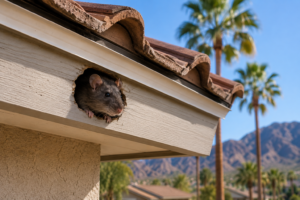 Common roof rat clues:
– Noises at night: roof rats are primarily nocturnal. Scratching or scurrying is often most noticeable after dark.
– Droppings: roof rat droppings are typically dark, spindle-shaped, and about 1/2 inch long. You may find them in the attic, garage corners, on top of stored items, or along rafters.
– Rub marks/grease trails: along beams, pipes, or entry points where they repeatedly travel.
– Chew damage: gnaw marks on stored boxes, wiring, or plastic. (Chewed wiring is a serious fire risk—don’t ignore it.)
– Outdoor signs: activity in palm skirts, along fences, or near fruit trees; sometimes you’ll see fronds shaking at night.
Because noises and outdoor movement alone may not confirm the species, compare the complete signs of a rodent infestation in Coachella Valley homes, including droppings, gnaw marks, nesting material, odors, and grease trails.
Pack rat clues (different approach may be needed):
– Piles of sticks/debris (middens) near cacti, shrubs, or stored items.
– More “nest building” with obvious debris.
Smaller droppings, activity inside walls, or signs closer to food-storage areas may point to a different rodent problem. Compare the typical entry routes and warning signs associated with mice in Coachella Valley homes.
If you’re unsure, a professional inspection can identify the species and, more importantly, the exact travel routes and entry points.
3) Solution step one: break the bridge (palm trimming and access control)
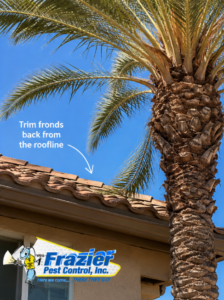
If palm fronds touch your roof, you’re giving roof rats a direct path. The goal is to create separation so rats can’t simply step from tree to structure.
What to do:
– Trim fronds back from the roofline. Aim for a clear gap so fronds do not rest on the roof, eaves, or gutters.
– Address dense palm skirts. Overgrown skirts provide hiding spots and make it easier for rats to linger near the canopy.
– Reduce “connected canopies.” If palms connect to other trees or vines that reach the roof, trim those back too.
– Watch the fence line. Roof rats often use fences as highways to reach palms and then the roof. If you have palms right next to a fence, the fence-to-palm-to-roof route is common.
Important: trimming alone rarely solves an active infestation. It’s a key access-control step, but if rats are already inside, you also need exclusion and removal.
Palm trimming works best as part of a broader yard-maintenance strategy. These pest-control landscaping tips for Coachella Valley yards explain how vegetation, fruit, debris, moisture, and structures near the home can support pest travel and shelter.
4) Solution step two: seal the home where roof rats actually get in
In desert communities, homes often have a mix of stucco, tile roofs, vents, and add-ons (solar, pool equipment, remodeled HVAC/duct runs). Roof rats take advantage of small construction gaps and aging materials.
Common entry points we see in Coachella Valley homes:
– Gable vents and attic vents (especially if screening is missing, torn, or too wide)
– Roof returns and fascia gaps
– Eave gaps at the roofline
– Plumbing and HVAC penetrations (where pipes/cables enter walls)
– Garage door corners and weather stripping failures
– Gaps under roof tiles at edges or transitions (varies by roof design)
Roofline openings may be only part of the problem. Inspect these additional hidden pest entry points around Coachella Valley homes, including gaps around utility lines, garage doors, vents, foundations, and exterior material transitions.
How to approach sealing (without creating new problems):
– Start with an inspection, not guesswork. Sealing the wrong areas first can trap animals inside, leading to odor issues or frantic damage.
– Use proper materials. Hardware cloth/metal screening and professional-grade exclusion materials hold up better than foam alone. (Foam can be part of a system, but it’s rarely “the” solution for rodents.)
– Prioritize high points. Roof rats typically enter higher elevations first (attic/roofline), then may move down into walls or garages.
If you’ve heard activity inside recently, it’s best to combine exclusion with a removal plan so you don’t end up with a sealed-in problem.
5) Solution step three: remove the current rats (targeted trapping + monitoring)
Once access is reduced and entry points are identified, removal is the next step. For roof rats, targeted trapping is often the most controlled approach.
Key principles:
– Place traps where rats travel, not where you wish they traveled. In attics, that’s often along rafters, near entry points, or along established runways.
– Use enough traps and check them consistently. A single trap in a random corner usually doesn’t keep up with an active situation.
– Monitor and adjust. If there’s no activity on a set, placement or bait strategy may need to change.
What to avoid:
– Relying on “one-and-done” store bait without a plan. Rodenticides can create secondary risks (pets/wildlife) and can lead to odor issues if a rat dies in a wall or attic. In many homes, the “mystery smell” weeks later is the real headache.
– Ignoring sanitation and attractants. If there’s accessible pet food, fallen citrus, open trash, or bird seed, you’re feeding the problem.
A professional program typically combines removal with exclusion so you’re not stuck in a cycle of catching the same problem over and over.
Frazier’s professional rodent removal service addresses rats, mice, gophers, and other rodent activity through service options tailored to the property and affected areas.
6) Prevention: keep roof rats from coming back (a realistic desert-home plan)
Once you’ve stopped the palm-to-roof route and closed entry points, prevention becomes much easier—and cheaper—than repeated infestations.
 A practical prevention checklist for Palm Springs-area homes:
– Palm maintenance schedule: keep fronds trimmed away from the roofline and reduce dense skirts that provide cover.
– Fruit and seed control: pick up fallen citrus promptly; avoid leaving bird seed out overnight.
– Trash discipline: use lidded bins and keep the area clean—especially after outdoor entertaining.
– Garage and storage habits: store items in sealed containers; avoid leaving doors cracked open at night.
– Seasonal inspections: after wind events, monsoon storms, or contractor work (solar, roofing, HVAC), re-check vents and penetrations. Small changes can reopen access.
When to Call for Roof Rat Help
If you’re hearing consistent attic noise, finding droppings, or seeing rats in palms near your roofline, it’s worth getting an inspection sooner rather than later. The longer roof rats are active, the more likely you’ll see insulation contamination, duct damage, and chewed wiring.
Frazier Pest Control works with homeowners across the Coachella Valley to identify the exact travel routes (including palm access), seal entry points correctly, and remove active roof rat activity with a plan designed to prevent repeat problems.
If you’re in Palm Springs, Palm Desert, Rancho Mirage, Desert Hot Springs, Indian Wells, Cathedral City, La Quinta, Indio, or Coachella, the fix is usually a combination of access control (palms), exclusion (home sealing), and targeted removal—done in the right order.
Request a Roof Rat Inspection
Hearing activity above the ceiling or seeing rats moving between palm trees
and your roofline? An inspection can help identify travel routes, active
areas, possible entry points, and landscaping conditions contributing to
the problem.
Roof-rat control for Palm Springs and communities throughout the
Coachella Valley.
Recent Comments