
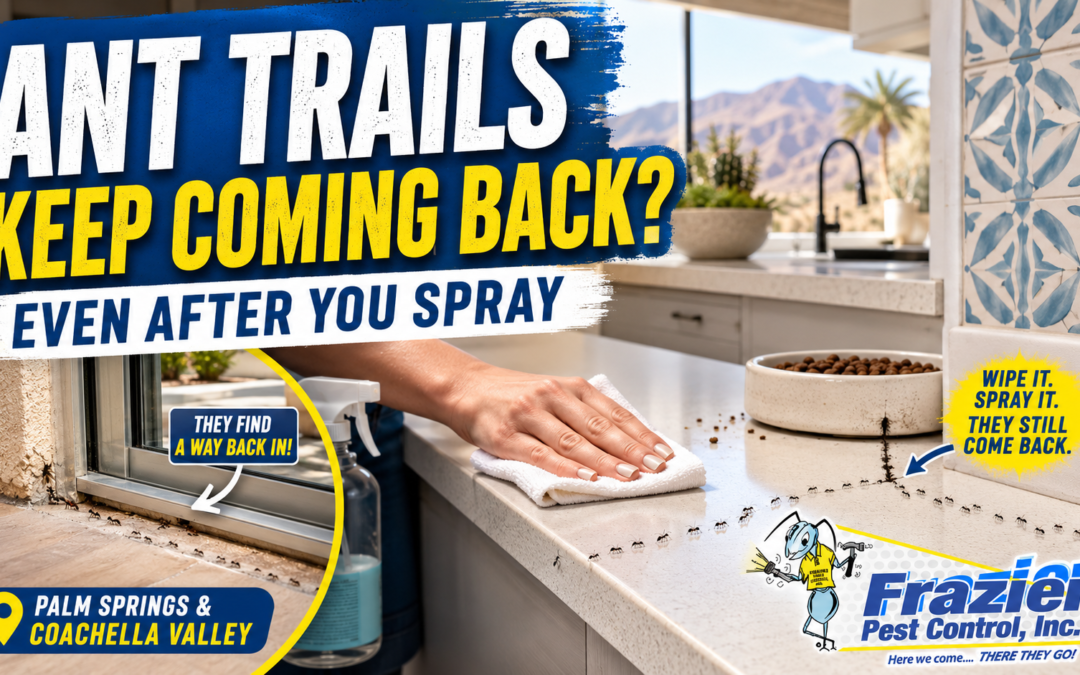
You wipe the counter, you spray the trail, and for a day or two the ants disappear. Then the same thin line shows up again—often in the exact same spot: along a baseboard in the kitchen, up a stucco crack by the patio slider, or marching toward a pet bowl in the laundry room.
In Palm Springs and across the Coachella Valley, this “they keep coming back” ant problem is one of the most common frustrations we hear at Frazier Pest Control. The reason isn’t that you didn’t spray enough. It’s that most sprays are designed to kill the ants you can see, not the colony that’s producing them.
Below is a practical, homeowner-friendly plan to stop ant trails from returning—built around how ants actually forage in desert neighborhoods like Palm Desert, Rancho Mirage, Cathedral City, La Quinta, Indio, Desert Hot Springs, Indian Wells, and Coachella.
Different ant species can have different nesting habits, food preferences, and control considerations. Review the common ants found around Coachella Valley homes if you need help understanding which type may be producing the trail.
1) The problem: why ant trails reappear after you spray
When you see a steady ant “highway,” you’re usually looking at foragers traveling between a food/water source and a nest (or multiple nests). Spraying that line can create three common outcomes:
• You only remove the current shift. The colony simply sends more foragers once the area is safe again.
• You break the trail temporarily, but not the cause. Ants re-route through a new crack, outlet gap, or door threshold.
• You trigger “budding” in certain species. Some ants respond to stress by splitting into multiple satellite colonies, which can make the problem feel bigger a week or two later.
Removing individual workers does not necessarily affect the nest or queen. Learn why killing visible ants can worsen an infestation and why the ants you see may represent only a small part of the colony.
In our area, ants are often driven as much by water as by food. During hot stretches, irrigation schedules, condensation lines, and small plumbing leaks can keep ants active even in very clean homes.
2) Identify what you’re actually dealing with
You don’t need to be an entomologist, but two quick observations help you choose the right approach.
A. Trail ants vs. scouts
• Scouts are the occasional single ant you see wandering. That can be a sign of a nearby colony, but it’s not a full trail yet.
• Trail ants move with purpose in a line, often using edges (baseboards, grout lines, the lip of a counter) and returning to the same path.
If you have a trail, you’re past “random visitors.” You need a colony-focused strategy.
B. Common Coachella Valley ant patterns
While there are multiple species in the desert, homeowners frequently run into:
• Argentine ants in the Coachella Valley: These ants can form large, connected colony networks and persistent trails around irrigated landscaping, kitchens, bathrooms, and other areas with dependable moisture or sugary food sources.
• Odorous house ants: Often drawn to sugary foods; trails can appear suddenly.
• Pavement ants: Common near driveways, patios, and slab edges; may enter through expansion joints and cracks.
Species matters because the best bait type (sweet vs. protein/grease) and the likelihood of budding can differ. If you’re unsure, the safest homeowner move is to avoid heavy repellent spraying and focus on baiting and exclusion.
If the insects have wings, do not automatically assume they are ordinary trail ants. Compare flying ants versus termites before applying treatment or disturbing the evidence.
3) The fix: a step-by-step plan that targets the colony (not the line)
If your goal is to stop ant trails from coming back, the strategy is: remove attractants, block access, and use the right products in the right places so ants carry the control back to the nest.
Step 1: Don’t spray the trail (at least not with repellent)
It’s counterintuitive, but if you spray a repellent aerosol directly on the trail, you can:
• Kill foragers before they can carry bait back
• Cause ants to split or re-route
• Make the infestation harder to track
If you need immediate relief on a countertop, use soap and water to wipe the trail and remove pheromones. That’s a “reset” without pushing the colony into a new path.
 Step 2: Find the “why here” attractant
Ants don’t keep returning to the same place for no reason. In desert homes, the usual culprits are:
• Sugar residue: coffee spills, soda drips, fruit bowls, syrup, honey
• Pet food and water bowls (especially overnight)
• Trash and recycling: sticky cans, juice boxes, wine bottles
• Moisture: under-sink seepage, a slow dishwasher leak, condensation from an AC line, a damp bath mat, or a plant that’s watered heavily indoors.
Ants need very little food to maintain an active trail. Check these frequently overlooked ways homeowners accidentally feed ants before assuming the kitchen, pantry, recycling area, or pet-feeding space is free of attractants.
Do a 5-minute inspection:
• Look under the sink with a flashlight for dampness or swelling in the cabinet base.
• Check around the fridge drip pan area and the dishwasher edge.
• Look for ants clustering at a specific corner – often that’s where moisture or crumbs are.
Repeated trails disappearing into plumbing gaps, baseboards, cabinets, outlets, or wall cracks may indicate ants nesting inside wall voids, particularly when food, moisture, warmth, and protected access are available.
Step 3: Use bait that matches the food preference
Bait is often the difference between “they’re back tomorrow” and “they’re gone for weeks.” The goal is for ants to take the bait to the colony.
• If ants are going for sweet items (fruit, soda, syrup): use a sweet-based bait.
• If they’re around grease/protein (trash, pet food, cooking areas): use a protein/grease-based bait.
Place bait where ants are traveling, but not where it will be wiped away or contaminated by cleaners. Good spots include:
• Along baseboards near the trail
• Under the lip of a counter overhang
• Inside a cabinet corner (away from food contact surfaces)
• Near entry points like sliding door tracks (protected from direct sun and water)
Important: Don’t put bait directly on a surface you’ll clean with strong chemicals. Many cleaners and sprays can repel ants and reduce bait acceptance.
Step 4: Reduce water access (this is huge in the Coachella Valley)
Even a perfect bait plan struggles if ants have abundant water. Focus on:
• Fixing small leaks (P-trap drips, faucet supply lines)
• Drying sink areas at night
• Emptying pet water bowls overnight for a few days (if appropriate for your pet’s routine)
• Checking irrigation overspray that hits the foundation—especially near kitchen or bathroom walls
• Ensuring AC condensate drains properly and doesn’t create a constant damp spot
In Palm Desert, Rancho Mirage, and La Quinta, we often see ant activity spike along walls that back up to heavily irrigated planters or drip lines.
 Step 5: Seal the easy entry points (exclusion)
 Step 5: Seal the easy entry points (exclusion)
You don’t need to seal the entire house in one day. Start with the areas where you see activity.
Common entry points in desert construction:
• Gaps at baseboards and tile transitions
• Plumbing penetrations under sinks
• Door thresholds and worn weatherstripping
• Sliding door tracks
• Cracks in stucco or slab edges
• Utility line penetrations (cable, AC lines)
Use appropriate sealant (often silicone or acrylic latex caulk indoors; exterior sealing may require different materials). The goal is to reduce access so baiting and treatment can finish the job.
Step 6: Give it time – and watch the pattern
With baiting, you may see increased activity for a short period. That can be normal as ants recruit to the food source. What you want to see over several days is:
• Trails thinning
• Fewer ants reaching the kitchen/bathroom
• No new trails forming
If trails keep popping up in multiple rooms, you may be dealing with multiple colonies or a species that’s prone to splitting—both situations where professional identification and a targeted treatment plan matter.
4) Common mistakes that make ant problems worse
Here are the big ones we see in Palm Springs-area homes:
• Spraying strong repellents everywhere. This often turns one trail into three.
• Cleaning away bait or placing bait where it gets wiped daily.
• Using the wrong bait type (sweet bait for protein-seeking ants, or vice versa).
• Ignoring moisture. A tiny leak can keep ants active even when food is locked down.
• Treating only indoors. Many ant issues are driven by exterior nesting and landscape conditions near the foundation.
Before trying another home treatment, review these DIY ant remedies that often fail. Removing visible ants without addressing the colony, moisture source, food supply, and entry route may provide only temporary relief.
Exterior conditions often determine whether ants continue returning. These pest-control landscaping tips for Coachella Valley yards explain how irrigation, vegetation, debris, storage, and contact with the building may support pest activity near the foundation.
5) When to call Frazier Pest Control (and what a professional visit should include)
If you’ve baited correctly for 7–10 days and trails are still returning, or if you’re seeing ants in multiple areas (kitchen, bathrooms, bedrooms), it’s time to bring in a pro.
A professional ant control visit should include:
• Species/behavior assessment (what kind of ant, what it’s attracted to)
• Exterior inspection: foundation, irrigation, landscape edges, entry points
• Targeted treatment plan: non-repellent products where appropriate, strategic baiting, and perimeter work based on the home’s layout
• Guidance on moisture and exclusion priorities (what will actually move the needle)
At Frazier Pest Control, we focus on stopping the colony pressure that keeps reintroducing ants – especially in Coachella Valley conditions where heat, irrigation, and indoor water sources can keep ants active year-round.
If you’re in Palm Springs, Palm Desert, Rancho Mirage, Desert Hot Springs, Indian Wells, Cathedral City, La Quinta, Indio, or Coachella and you’re tired of the same ant trail coming back after every spray, the fix is usually a smarter combination of baiting, moisture control, and entry-point reduction—not more aerosol.
The sooner you address it, the less likely you are to end up with multiple trails and multiple nesting sites.
Ready to stop the ant trails for good? Contact Frazier Pest Control to schedule an inspection and targeted ant control service for your home in Palm Springs and the Coachella Valley. (760) 328-6115
Recent Comments