
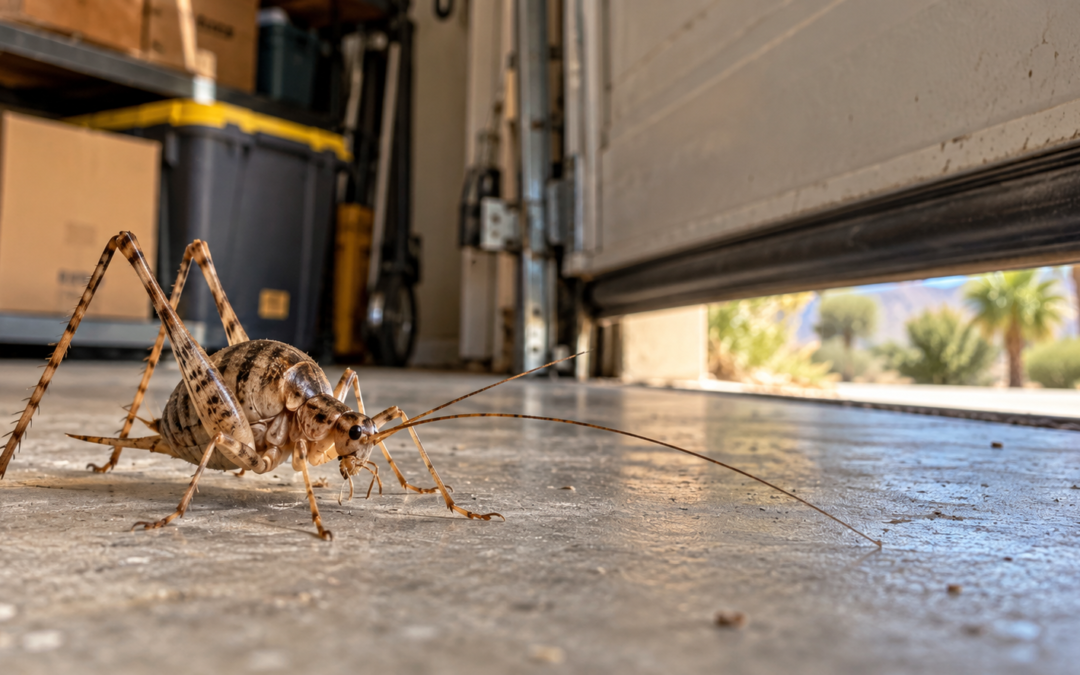
If you’re seeing spider crickets (also called camel crickets) hopping around your garage, the real question usually isn’t “Where did that one come from?” It’s: what conditions around your Palm Springs-area home are making the garage a good staging area—cooler pockets, moisture, cluttered shelter, and easy entry gaps. The fastest way to reduce sightings is to remove what attracts them (moisture and hiding spots) and block how they’re getting in (door gaps, cracks, and utility penetrations). If sightings keep happening after you tighten up those basics, it’s often a sign there’s a repeatable pathway or a nearby harborage that needs a more thorough inspection.
Below is a practical, homeowner-friendly way to think about spider crickets in a garage—what it means, what to check first, and what to do next.
1) The problem: why spider crickets keep showing up in your garage
Spider crickets are not like the “chirping” crickets you might hear outside. They’re more likely to be noticed because they startle people—jumping suddenly when the lights come on or when you move a box. In garages, repeated sightings usually point to one (or more) of these conditions:
– The garage offers a stable microclimate. Even in desert cities, garages can have cooler corners, shaded sides, or areas near water heaters/HVAC equipment that stay slightly more humid than the yard.
– There are plenty of hiding places. Cardboard boxes, stored fabric, stacked items, and clutter along walls create protected spaces that are hard to inspect and easy for pests to use.
– The garage is a “transition zone.” Garages often have more gaps than interior living spaces—around the door, at the slab edge, and where pipes and conduits enter.
What it signals: spider crickets are often a symptom pest. They may be telling you there’s moisture, harborage, or an entry route that other pests can also use. That doesn’t mean you automatically have a bigger infestation, but it does mean the garage is functioning like an easy-access buffer between outdoors and indoors.
2) What’s attracting them: the three garage magnets (moisture, shelter, food)
If you want fewer spider crickets, you want a less “comfortable” garage. Focus on these three magnets.
A) Moisture (even small amounts)
In desert climates, “moisture” doesn’t have to mean standing water. It can be subtle:
– A slow leak at a water heater pan or nearby plumbing
– Condensation from HVAC lines or a mini-split drain
– A damp corner where irrigation overspray hits the slab near the garage wall
– Stored items that trap humidity (tarp piles, wet mops, damp cardboard)
What to do today:
– Walk the perimeter and look for any damp staining on the slab or lower wall.
– Check the water heater area and any nearby shutoff valves.
– If you have a floor drain or a rarely used sink, confirm there’s no ongoing seepage.
B) Shelter (clutter and “soft storage”)
Spider crickets like protected spaces. Garages often provide exactly that:
– Cardboard boxes on the floor
– Stored clothing, paper, and holiday décor
– Stacks of bags, coolers, and folded furniture
What to do today:
– Get items off the floor using shelving.
– Replace cardboard with sealed plastic bins where possible.
– Keep a clear inspection strip (6–12 inches) along the garage walls so you can see activity.
C) Food sources (often indirect)
Spider crickets can feed on organic debris, fungi, and other materials. In garages, food sources are often indirect:
– Pet food storage that isn’t sealed
– Spilled bird seed or grass seed
– Organic debris that collects along the garage door threshold
– Damp cardboard or paper that starts to break down
What to do today:
– Store pet food/seed in sealed containers.
– Sweep the garage door track/threshold area regularly.
– Remove old boxes that have gotten soft or damp.
3) How they’re getting in: the most common entry points to check
A single spider cricket can wander in, but repeated sightings usually mean repeatable access. Garages have predictable weak spots.
A) Garage door bottom seal and side seals
If you can see daylight under the door, pests can often get in. Even small gaps matter.
– Check the bottom seal for cracks, flattening, or sections that don’t contact the slab.
– Check the side seals where the door meets the frame.
B) The “corner gaps” and slab edge
Garages often have small separations where the slab meets the wall or at corners where materials shift over time.
– Look for hairline cracks and small openings along the base.
– Pay attention to the side of the garage that stays shaded.
C) Utility penetrations
Wherever a pipe, conduit, or line enters the garage wall, there can be a gap.
– Inspect around water lines, gas lines, AC lines, and electrical conduits.
– Look for old, crumbling sealant or openings that were never sealed tightly.
D) Door from garage to house (and the threshold)
Even if the crickets are “only in the garage,” the door to the interior is a key checkpoint.
– Check the door sweep and weatherstripping.
– Make sure the threshold is tight and not warped.
What “good” looks like: you shouldn’t be able to see daylight around doors, and penetrations should be sealed cleanly with appropriate materials. If you’re not sure what to use or how to seal without creating other issues, that’s a good moment to ask a pro during an inspection.
4) The solution: a stop-the-problem plan that actually reduces sightings
If you want a plan that’s more than “spray and hope,” use this sequence. It’s designed to reduce the conditions that keep bringing spider crickets back.
Step 1: Reset the garage environment (one-time deep tidy)
– Pull items away from walls.
– Remove damp or deteriorating cardboard.
– Vacuum/sweep corners, behind appliances, and along the door line.
Why it matters: if you can’t see the perimeter, you can’t confirm whether your fixes are working.
Step 2: Reduce moisture sources (small fixes, big impact)
– Repair leaks (even slow ones).
– Redirect irrigation overspray away from the garage wall.
– Don’t store wet items on the slab.
Why it matters: moisture is one of the strongest drivers of repeat activity in garages.
Step 3: Tighten exclusion (seal the “repeatable pathway”)
– Replace worn garage door seals.
– Seal utility penetrations.
– Address slab-edge gaps and cracks where appropriate.
Why it matters: exclusion turns a recurring pest issue into an occasional one.
Step 4: Add monitoring so you know what’s happening (not guessing)
– Use simple monitoring tools (for example, checking corners and behind stored items on a schedule).
– Track where you see activity: which wall, which corner, which door.
Why it matters: patterns tell you where the entry point or harborage is.
Step 5: Consider targeted treatment only after steps 1–3
A targeted approach (rather than broad, repeated spraying) is typically more effective when you’ve already reduced harborage and sealed access points. If you treat without fixing moisture and entry gaps, you may get temporary relief but keep seeing new activity.
5) When DIY stops working: signs it’s time to call Frazier Pest Control
A garage pest issue is often solvable with basic cleanup and sealing, but there are clear signs you’ll benefit from a professional inspection and plan:
– You keep seeing spider crickets weekly even after you’ve reduced clutter and checked door seals.
– You find them in multiple areas (garage plus laundry room, bathrooms, or closets).
– You can’t identify where they’re coming from, or the likely entry points are hard to access.
– You suspect a moisture issue you can’t locate (for example, intermittent dampness or staining).
A pest professional can help you confirm whether the garage is the main issue or whether there’s an exterior harborage zone that needs attention, then prioritize the fixes that will actually reduce repeat sightings.
Local note for the Coachella Valley: homes across Palm Springs, Palm Desert, Rancho Mirage, Desert Hot Springs, Indian Wells, Cathedral City, La Quinta, Indio, and Coachella often have garages that function as storage-heavy transition spaces. That makes them a common place for “surprise” pest sightings—especially when small gaps, moisture, and clutter overlap.
If your goal is simple—fewer spider crickets and fewer unpleasant surprises when you open the garage—focus on the conditions and the entry points first. Then, if the problem persists, get a professional set of eyes on the structure so you’re not chasing the same issue month after month.
If you’re dealing with spider crickets in your garage and want a clear plan to stop repeat sightings, contact Frazier Pest Control to schedule an inspection and targeted treatment strategy for your home.
Recent Comments