
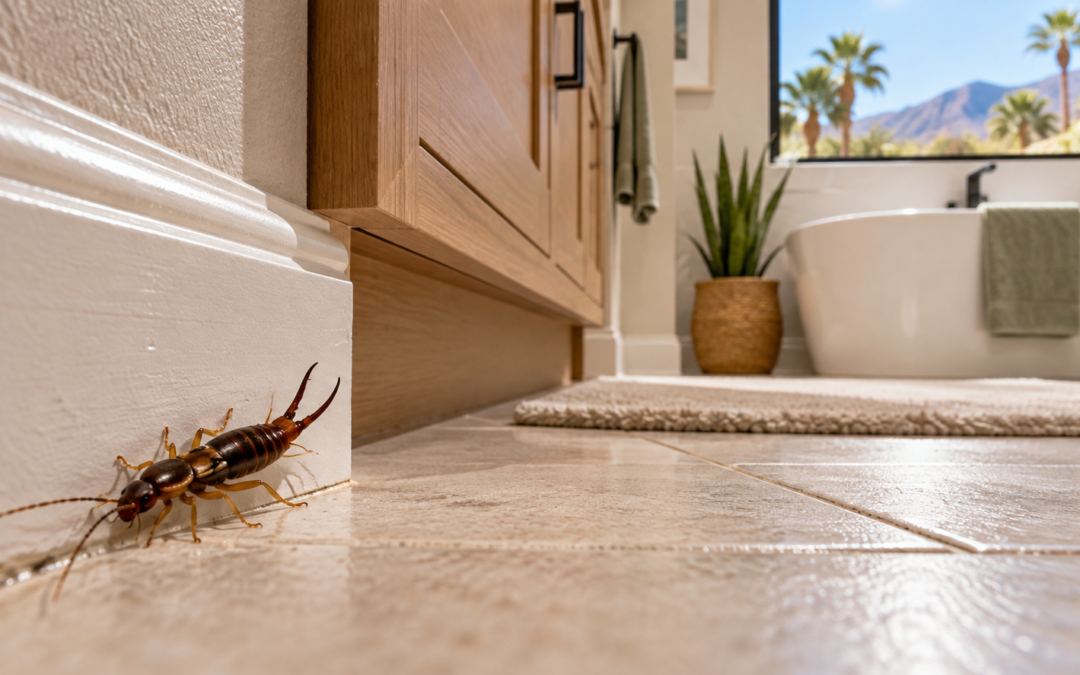
If you’re waking up to earwigs in your bathroom—on the tub edge, near the baseboards, or around the sink—this usually isn’t random. In Palm Springs and the rest of the Coachella Valley, bathrooms are one of the most common “collection points” for earwigs because they combine three things earwigs love: moisture, darkness, and tight hiding spots.
The good news: you can usually stop the overnight appearances by fixing a few specific conditions. The key is to treat this like a moisture-and-entry problem, not just a “spray the bug” problem.
The specific problem: why earwigs show up in bathrooms overnight
Earwigs are primarily outdoor insects. They hide during the day and become more active at night. When conditions outside push them to roam—heat swings, irrigation, landscaping moisture, or simply a strong local population—they’ll follow moisture and shelter cues.
Bathrooms are attractive because:
– They have steady humidity from showers and sinks.
– They have hidden voids (under vanities, behind toilets, around plumbing penetrations).
– They often have small gaps at thresholds and around pipes.
– They’re quiet and dark at night.
So when you see earwigs “suddenly” in the bathroom, it’s usually because they’re entering from outdoors or wall voids and then concentrating where moisture is highest.
Why it happens in Coachella Valley homes (moisture + entry points + outdoor pressure)
In Palm Springs, Palm Desert, Rancho Mirage, Desert Hot Springs, Indian Wells, Cathedral City, La Quinta, Indio, and Coachella, earwig activity often spikes when outdoor moisture increases—especially around irrigated planters, drip lines, shaded side yards, and areas where water collects near the foundation.
Here are the most common drivers we see locally:
A) Outdoor moisture near the foundation
Even in a desert climate, many properties create “micro-climates” around the home:
– Drip irrigation that runs too long or too frequently
– Overspray hitting stucco or pooling at the slab edge
– Leaky valves or emitters soaking mulch
– Dense ground cover holding moisture against the wall
Earwigs hide in damp mulch, leaf litter, and under pots or edging. If that habitat is right next to the home, it increases the odds they’ll wander inside.
B) Entry points that are easy to miss
Earwigs don’t need a big opening. Common entry points include:
– Worn door sweeps (especially at garage-to-house and exterior doors)
– Gaps at sliding door tracks
– Cracks at the slab edge or expansion joints
– Plumbing penetrations under sinks (kitchen and bathroom)
– Gaps around shower valves or tub plumbing access panels
Once inside, they follow baseboards and edges until they find a humid, protected spot—often the bathroom.
C) Bathroom conditions that “invite” them to stay
Even if only a few earwigs get in, certain bathroom conditions make it easier for them to survive:
– A slow drain or damp overflow area
– A small leak under the vanity
– Condensation around supply lines
– Wet bath mats or towels left on the floor
– A rarely used guest bathroom where water sits in traps and humidity lingers
DIY fixes that actually reduce earwigs (in the right order)
If you want results fast, do these in order. Each step reduces the “why” behind the problem.
Step 1: Remove the moisture cue in the bathroom
– Run the bathroom exhaust fan during showers and for 20–30 minutes after.
– Fix any slow drip under the sink or at the toilet supply line.
– Keep bath mats dry; hang towels instead of leaving them on the floor.
– If it’s a guest bath, run water in the sink/shower weekly and keep the room ventilated.
What to look for: open the vanity and feel around the P-trap and shutoff valves. Even a tiny seep can keep the cabinet base damp.
Step 2: Seal the “easy” indoor gaps
Focus on the places earwigs use as highways:
– Under-sink plumbing holes: use a proper escutcheon or seal gaps (without sealing in active leaks).
– Baseboard gaps behind the toilet and at vanity kick plates.
– Around the tub/shower plumbing access panel (if present).
You’re not trying to make the home airtight; you’re blocking the obvious pathways that lead directly into the bathroom.
Step 3: Fix door thresholds and sweeps
A surprising number of bathroom earwig issues start at exterior doors or the garage door into the house.
– Replace worn door sweeps.
– Check daylight under doors at night.
– Make sure weatherstripping is intact.
If earwigs are entering from the garage, they often end up in bathrooms because the plumbing wall chases connect and humidity draws them.
Step 4: Reduce earwig habitat outside (especially near the bathroom wall)
This is where most long-term wins happen.
– Pull mulch, leaf litter, and dense ground cover back 12–18 inches from the foundation where possible.
– Move pots off the slab and away from door thresholds.
– Avoid storing damp items (mops, pool toys, wet towels) against exterior walls.
– Check irrigation: reduce run time, fix leaks, and prevent water from pooling at the slab edge.
If you have a heavily shaded side yard with drip irrigation, that’s a classic earwig source zone.
Step 5: Use targeted exterior control instead of indoor “fogging”
If you choose to use a consumer product, focus on the exterior perimeter and harborage areas rather than spraying inside the bathroom repeatedly.
– Treat cracks/crevices and the perimeter where earwigs hide.
– Avoid contaminating areas where kids/pets contact surfaces.
– Follow the label exactly.
Indoor spraying often gives temporary relief but doesn’t address the outdoor population that keeps replenishing.
What not to do (common mistakes that keep the problem going)
These are the patterns that lead to “we keep seeing them every night”:
Mistake A: Only killing the ones you see
If you’re only reacting to sightings in the bathroom, you’re treating the symptom. Earwigs are coming from somewhere: exterior habitat, door gaps, or wall voids.
Mistake B: Overwatering landscaping because “it’s the desert”
Many Coachella Valley properties unintentionally create a damp band around the home. Earwigs thrive in that band, even when the rest of the yard looks dry.
Mistake C: Ignoring the garage-to-house door
This door is often the weakest seal in the home. If it has a gap, insects enter the garage and then migrate indoors.
Mistake D: Using indoor bombs/foggers
Foggers don’t penetrate the cracks where earwigs hide, and they don’t solve the exterior source. They can also create unnecessary exposure indoors.
When it’s time for professional help (and what a targeted treatment looks like)
If you’ve reduced moisture, sealed obvious gaps, and you’re still seeing earwigs regularly—especially multiple per night—it’s usually a sign of strong exterior pressure or hidden entry points.
A professional approach typically focuses on:
– Inspecting the exterior perimeter, especially shaded/moist zones and irrigation lines near the foundation
– Identifying entry points (thresholds, weep areas, utility penetrations, cracks)
– Applying targeted treatments to exterior harborage and perimeter zones where earwigs travel
– Advising on irrigation and landscape adjustments that reduce the conditions earwigs need
At Frazier Pest Control, the goal is to stop the “replenishment cycle” so the bathroom sightings drop off quickly and stay down.
A simple 7-day checklist to confirm you’re winning
Use this to track progress without guessing:
Day 1–2:
– Dry the bathroom aggressively (fan use, mats up, wipe condensation)
– Check under-sink for leaks
– Note where earwigs are found (tub, vanity, baseboard, near door)
Day 3–4:
– Seal/close the most obvious gaps (under-sink penetrations, baseboard voids)
– Replace or adjust door sweeps where you see daylight
Day 5–7:
– Adjust irrigation near the home (shorter cycles, fix leaks)
– Remove damp harborage near the bathroom wall (mulch/pots/debris)
What success looks like:
– Sightings drop from nightly to rare/none
– Earwigs you do see are usually near an entry point (helpful for pinpointing the last gap)
If you’re still seeing them nightly after a week of these steps, it’s a strong indicator that an exterior source zone needs to be treated and/or a hidden entry point needs to be identified.
Earwigs in a Palm Springs bathroom are annoying, but they’re also predictable. Once you remove the moisture cues, block the easy routes, and reduce the outdoor pressure near the foundation, the “overnight surprise” usually stops.
Tired of finding earwigs in your bathroom every morning? Contact Frazier Pest Control to inspect entry points, reduce exterior pressure, and set up a targeted plan that works for your home.
Recent Comments