

In the Coachella Valley, late summer into early fall is when a lot of homeowners notice a frustrating pattern: you open a cabinet for flour, rice, or cereal and a small tan moth flutters out. A week later, there are more. You toss one bag of food, wipe a shelf, and somehow the moths keep returning.
If you’re dealing with pantry moths in Palm Springs (or anywhere from Palm Desert to Indio), the key is understanding one thing: the moths you see are usually the last stage of the problem, not the beginning. The real issue is almost always hidden in a single “source” item and the eggs/larvae that have spread into cracks, shelf holes, and packaging seams.
Below is a seasonal, step-by-step approach that works well for desert homes—especially when warm indoor temps and busy schedules make pantry pests more likely to get established.
1) Why pantry moths spike in desert homes (and why they keep coming back)
Pantry moths (often called Indian meal moths) don’t show up because your home is “dirty.” They usually arrive already inside packaged food. That can be:
– Flour, rice, pasta, cereal, oats
– Nuts, dried fruit, chocolate
– Spices, tea, pet food, bird seed
– Bulk goods stored in garages or laundry rooms
Pantry moths are a clear example of why pest activity is not always caused by poor housekeeping. Learn more about why pests can appear even in clean homes and which overlooked spaces may allow activity to remain hidden.
In our area, two things make them feel nonstop once they start:
– Warm indoor temperatures: Even with AC, kitchens and pantries can stay warm enough for faster development.
– Multiple storage zones: Many Coachella Valley homes store extra dry goods in a garage or utility room. If one bag of pet food or bird seed is infested out there, the kitchen can keep getting “re-seeded.”
Why they keep coming back after you “cleaned”:
– Eggs and larvae are not removed by a quick wipe-down.
– The source item wasn’t found (or a second source exists).
– Infested items were moved to another cabinet or trash can indoors.
– Open packages were left in place (cardboard and thin plastic are easy for larvae to exploit).
2) Confirm it’s pantry moths: what to look for in the kitchen and garage
Before you go into full reset mode, make sure you’re targeting the right pest.
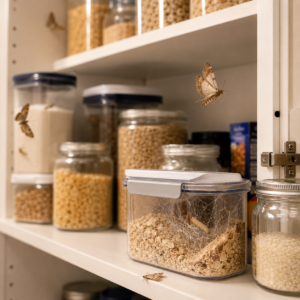 Common pantry moth signs:
– Small tan/gray moths that fly in short, fluttery bursts, often near cabinets or ceilings
– Webbing in corners of packages or along container lids
– Clumped grains (larvae webbing can make rice or flour look “stringy”)
– Tiny off-white larvae (caterpillar-like) inside packaging seams or crawling on shelves
– Cocoons/pupae in cabinet corners, shelf pin holes, or along door hinges
Where to look first:
– The oldest opened bag of flour, rice, cereal, or pet food
– Bulk bins or “decanted” items in thin containers
– Forgotten snacks in the back of a cabinet
– Garage storage: bird seed, dog treats, livestock feed, or bulk rice/beans
A quick reality check: If you only check the kitchen but the true source is in the garage, you can clean the pantry perfectly and still see moths again.
When moth activity stays concentrated around one cabinet, pantry, kitchen, or garage, that location may be close to the source. This guide explains why pest activity may remain concentrated in one room and why checking adjacent storage areas matters.
3) The 60-minute reset: isolate food, deep-clean the right way, and remove eggs/larvae
This is the part most people partially do. Partial steps usually mean partial results.
Step A: Stop the spread (10 minutes)
– Turn off ceiling fans in the kitchen so moths don’t get blown around.
– Grab a large trash bag and a few sealable bags.
– Remove everything from the affected cabinet(s) and set it on a table or counter.
Step B: Identify the source item (15–20 minutes)
Work category by category and inspect packaging seams and corners.
– Opened bags are the top suspects.
– Cardboard boxes with inner bags can hide infestation between layers.
– Pet food bags are common sources—especially if stored warm.
What to do with suspicious items:
– If you see larvae/webbing: seal it in a bag immediately and take it outside to the trash.
– If you’re unsure but it’s cheap to replace: discard it.
– If it’s expensive and you want to try saving it: you can freeze it (see prevention section), but do not keep it in the pantry unprotected.
Step C: Vacuum like you mean it (15 minutes)
Wiping alone won’t remove eggs in cracks.
– Use a crevice tool.
– Vacuum shelf corners, shelf pin holes, hinges, door seams, and any cracks.
– Vacuum the underside of shelves and the cabinet frame.
Immediately after vacuuming:
– Remove the vacuum contents (or bag), seal it, and take it to the outside trash. Don’t leave it in an indoor can.
Step D: Clean surfaces correctly (10–15 minutes)
– Use warm soapy water to wipe shelves and cabinet walls.
– For stubborn residue, a mild degreaser can help.
– Avoid soaking cabinet seams; you want clean and dry.
Important: Spraying random aerosol insecticide inside food cabinets is not a good plan. It can contaminate surfaces and still miss the eggs/larvae hidden in cracks.
Step E: Reset storage (5 minutes)
Only put back items you’ve inspected and decided to keep—preferably in sealed containers.
4) Prevention that actually works in Coachella Valley kitchens (storage, rotation, and monitoring)
Once you’ve removed the source and cleaned correctly, prevention is what keeps the problem from restarting.
Use real containers (not just clips)
– Transfer flour, rice, cereal, and pet treats into hard, airtight containers (thick plastic or glass with gasket lids).
– Thin plastic bags and cardboard are not moth-proof.
Airtight storage becomes especially important when baking supplies and dry ingredients are being used frequently. Review these additional steps for preventing kitchen pests around food-storage areas, particularly during busy cooking and holiday periods.
Freeze “high-risk” items when you bring them home
If you buy in bulk or store items for long periods:
– Freeze dry goods for 3–4 days (or follow safe freezing guidance for pantry pests) before transferring to containers.
– This is especially helpful for flour, nuts, and bird seed.
Rotate inventory like a restaurant
– Put newer items behind older ones.
– Label containers with purchase dates.
– Don’t keep half-open bags “just in case.” That’s how infestations linger.
Don’t forget the garage
In the desert, garages can be a major pantry moth incubator.
– Store pet food and bird seed in sealed bins.
– Avoid leaving opened bags on shelves.
– If you see moths in the garage, treat it as part of the same problem.
Use monitoring traps strategically
– Pantry moth pheromone traps can help you confirm activity and track progress.
– Place them near (not inside) cabinets or in the pantry area.
– Traps won’t solve an infestation alone, but they’re useful for early detection.
5) When DIY isn’t enough: what a professional pantry moth treatment targets
If you’ve done the reset and you’re still seeing moths after a couple of weeks, one of these is usually true:
– A source item was missed (often in a different room)
– Eggs/larvae remain in cabinet voids or hard-to-reach areas
– The infestation is spread across multiple cabinets or storage zones
Repeated moth sightings, fresh webbing, larvae, or activity across multiple storage areas suggest more than one moth that wandered into the kitchen. Compare the signs of an occasional pest sighting or an established infestation before deciding whether continued monitoring is enough.
A professional approach focuses on:
– Confirming the pest and locating the source(s)
– Inspecting adjacent areas (kitchen, laundry, garage) to stop reintroduction
– Targeted treatment to cracks/crevices and non-food contact areas where larvae pupate
– Practical storage and prevention guidance tailored to your home’s layout
When source removal, cleaning, sealed storage, and monitoring do not resolve the activity, Frazier’s professional moth and bug-control services can help confirm the pest, inspect affected areas, and determine an appropriate treatment plan.
At Frazier Pest Control, the goal is not just to “knock down” the flying moths you see—it’s to break the life cycle so you’re not repeating the same cleanup every month.
6) Quick checklist and next steps for Palm Springs–to–Coachella homeowners
If you want a simple plan you can follow today:
– Find and discard the source item (and any questionable opened goods)
– Vacuum cracks, corners, shelf holes, and hinges
– Remove vacuum debris to the outside trash immediately
– Wipe shelves with warm soapy water and dry thoroughly
– Move dry goods into airtight containers
– Check garage storage (pet food/bird seed/bulk goods)
– Set 1–2 monitoring traps to confirm activity is dropping
If you’re still seeing pantry moths after doing the above, it’s time to bring in help—especially if the infestation is spread across multiple cabinets or you suspect a hidden source.
Pantry moth activity can often be reduced by locating the source, removing affected products, cleaning hidden pupation sites, and improving food-storage practices. Continued sightings may indicate that another source item or storage area still needs attention. If you’re in Palm Springs, Palm Desert, Rancho Mirage, Desert Hot Springs, Indian Wells, Cathedral City, La Quinta, Indio, or Coachella, Frazier Pest Control can help you identify what’s driving the infestation and stop it at the root.
Request a Pantry Moth Inspection
Still seeing pantry moths after inspecting dry goods, cleaning cabinet cracks,
and moving food into airtight containers? A professional inspection can help
confirm the pest, locate overlooked source items, and identify areas where
larvae may be pupating.
Recent Comments