
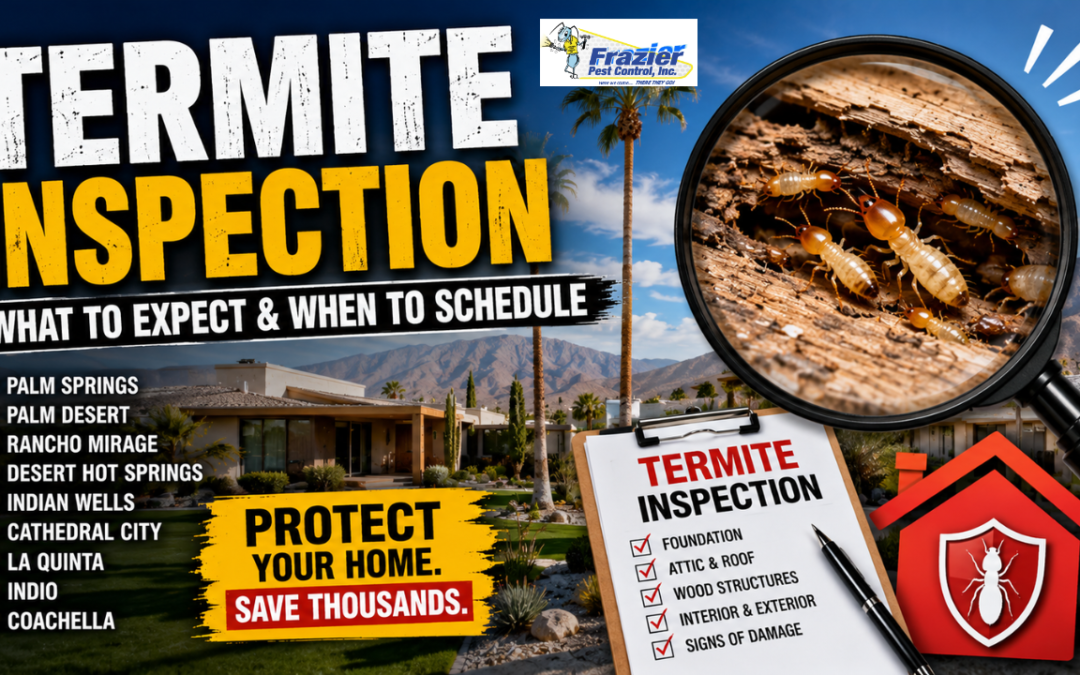
A professional termite inspection in Palm Springs helps identify visible evidence of termite activity, accessible wood damage, and conditions that can make a property more vulnerable. Frazier Pest Control serves homeowners, buyers, sellers, property managers, and HOA communities across Palm Springs, Palm Desert, and the Coachella Valley with a clear, prevention-focused inspection process.
| Quick answer: A termite inspection generally includes an examination of accessible exterior and interior areas for mud tubes, discarded wings, termite pellets, damaged wood, moisture, and wood-to-soil contact. The inspector should explain what was found, whether the evidence may involve drywood or subterranean termites, and which next steps fit the property. The exact scope depends on the structure, access, and the type of report requested. |
Concerned about possible termite activity? Call Frazier Pest Control at (760) 328-6115 or contact Frazier Pest Control to request an inspection.
Why Termite Inspections Matter in Desert Communities
A dry climate does not eliminate termite risk. Desert properties still contain the wood termites consume, while irrigation, plumbing leaks, shaded foundation areas, and landscape features can create localized moisture. Wood trim, fence posts, planters, stored lumber, and cellulose debris near soil may also provide access or food sources. Learn more about termite risks in desert homes.
Termite activity can remain concealed within wood, behind finished surfaces, below slabs, or in soil. In particular, subterranean termites can stay hidden while traveling through soil and shelter tubes. An inspection cannot reveal every concealed condition, but it can identify accessible evidence, narrow the areas of concern, and help determine whether additional evaluation or treatment is appropriate.

Signs You May Need a Termite Inspection
Schedule an inspection promptly if you notice one or more of the following:
- Mud tubes on a foundation, garage wall, stem wall, crawlspace surface, or other route between soil and wood.
- Winged insects or piles of discarded wings near windows, doors, lights, or indoor emergence points.
- Small piles of dry, grain-like termite pellets below wood trim, eaves, windows, doors, or furniture.
- Wood that sounds hollow, feels soft, or shows blistering, cracking, or unexplained surface damage.
- Paint or drywall that bubbles in a way that resembles moisture damage.
- Doors or windows that begin sticking when moisture or damaged wood may be involved.
- A history of termite activity, treatment, or repairs at the property.
Winged insects are easy to misidentify. If you are unsure whether you saw flying ants and termites, save a sample when practical or take clear photos before cleaning the area. A single sign does not establish the species, activity level, or extent of damage; inspection is the next step.
Drywood vs. Subterranean Termites in the Coachella Valley
Correct identification matters because drywood and subterranean termites live differently and may require different management approaches. The table below is a quick guide, not a substitute for professional identification.
| Comparison | Drywood termites | Subterranean termites |
|---|---|---|
| Typical nesting area | Inside dry, sound wood above ground | In soil or other moist, protected locations with routes to wood |
| Common visible clue | Small, hard fecal pellets and discarded wings | Mud or shelter tubes, swarmers, and wood damage that may contain soil |
| Moisture/soil connection | Does not need soil contact | Usually maintains a connection to soil or moisture |
| Inspection focus | Eaves, trim, frames, attics, exposed wood, furniture, pellet locations | Foundation, slab edges, garages, crawlspaces, plumbing areas, wood-to-soil contact |
What Does a Professional Termite Inspection Include?
The exact process varies with the property and the requested report, but a professional inspection commonly includes the following steps.
Initial Property Walkthrough
The visit should begin with questions about what you have seen, where it appeared, when it started, and whether the property has had previous termite work. Share photos, repair records, known leaks, recent remodeling, and locations where wings, pellets, tubes, or damaged wood were found.
Exterior and Foundation Inspection
Accessible exterior areas are checked for shelter tubes, damaged wood, cracks or joints that may provide concealed routes, wood-to-soil contact, landscape materials against the structure, and moisture near the foundation. Gates, side yards, garages, patios, attached structures, fence connections, and accessible crawlspaces may be relevant depending on the property.
Accessible Interior Inspection
Inside, the inspector may examine accessible baseboards, door and window frames, garages, utility areas, plumbing penetrations, attic components, and any place where the owner has noticed suspicious damage or debris. A standard visual inspection generally does not include opening finished walls or moving permanently installed materials unless a separate scope has been authorized.
Moisture and Conducive-Condition Check
Leaks, irrigation overspray, poor drainage, cellulose debris, soil or mulch held too high against the building, and blocked access can increase risk or make evidence harder to see. Pay particular attention to moisture around a water heater, plumbing penetrations, utility rooms, and garages. These property-level differences help explain why some homes experience more pest pressure than nearby homes.
Findings and Recommended Next Steps
After the inspection, ask for a clear explanation of the evidence, the areas that were inaccessible, the likely termite type when identification is possible, and the recommended next step. Depending on the findings, that may involve monitoring, correcting moisture or access conditions, further inspection, treatment, or repair by an appropriate contractor.
When Should You Schedule a Termite Inspection?
Schedule an inspection when new warning signs appear, before making repairs that could cover the evidence, after discovering suspicious damage during a remodel, or when prior termite activity requires follow-up. Buyers, sellers, landlords, HOAs, and property managers may also need an inspection as part of a transaction, maintenance plan, or lender request.
There is no single interval that fits every property. The right schedule depends on the building’s history, construction, visible warning signs, moisture conditions, previous infestations, treatment warranties, and whether the inspection is connected to a sale or loan. Properties with new evidence or prior activity may need evaluation sooner than properties without known risk factors.
Termite Inspections for Home Buyers, Sellers, and HOAs
A general termite inspection and a formal California wood-destroying-organism report are not automatically the same service. If the inspection is for a real estate transaction, lender, escrow, HOA record, or repair certification, explain that purpose before booking and ask exactly which written report will be provided. Confirm that the company and inspector hold the license classification required for the requested work. California consumers can also review filed WDO activity through the state’s Wood Destroying Organism System.
Buyers should ask which areas were inaccessible and whether further evaluation is recommended. Sellers should avoid covering damage before it is documented. HOA and property managers should keep reports, treatment records, access notes, and follow-up dates organized by building or unit.
How to Prepare for a Termite Inspection
- Clear stored items away from accessible garage and utility-room walls where practical.
- Unlock exterior gates and provide safe access to the full perimeter, side yards, attic entries, crawlspaces, and affected rooms when applicable.
- Move furniture or boxes that block the specific area where evidence was seen, without disturbing the evidence itself.
- Collect prior inspection reports, treatment records, warranties, repair invoices, and photos.
- Write down where and when you saw wings, pellets, tubes, damaged wood, or moisture.
- Tell the inspector about active leaks, irrigation problems, remodeling, or areas that cannot be accessed.
What Not to Do Before the Inspection
- Do not remove mud tubes, pellets, wings, or damaged materials before documenting them with photos and showing the inspector.
- Do not spray over-the-counter pesticide into the area before the inspection; it can disturb visible activity without resolving a hidden colony.
- Do not paint, patch, caulk, or cover suspicious damage before it is evaluated.
- Do not assume every winged insect is a termite or that every damaged board proves an active infestation.
- Do not block the inspector’s access with vehicles, locked gates, storage, or unsecured pets.
What Happens If Termites Are Found?
Finding termites does not automatically mean the entire home requires the same treatment. Recommendations should account for the termite type, the location and apparent extent of activity, accessibility, construction, prior treatments, and conditions that may contribute to reinfestation.
Treatment options may include localized work, soil or foundation approaches, baiting or monitoring systems, removal of damaged materials, or whole-structure measures in appropriate drywood-termite situations. Read why termite treatment does not always require tenting, then ask the inspector to explain why the recommended option fits the findings at your property.
Areas We Serve for Termite Inspections
Frazier Pest Control serves Palm Springs, Palm Desert, Rancho Mirage, Desert Hot Springs, Indian Wells, Cathedral City, La Quinta, Indio, Coachella, and nearby Coachella Valley communities. You can also review our pest control services in the Coachella Valley for help with other property pest concerns.
Frequently Asked Questions
What happens during a termite inspection?
- The inspector reviews your concerns, checks accessible exterior and interior areas for evidence of termites and wood damage, notes moisture and other conducive conditions, and explains the findings and next steps. The exact scope depends on access, construction, and the type of report requested.
How long does a termite inspection take?
- Inspection time varies with the property’s size, construction, access, number of structures, and the areas of concern. Ask for a time estimate when booking and make sure garages, gates, attics, crawlspaces, and affected rooms are accessible as requested.
How should I prepare my home?
- Clear reasonable access to perimeter walls, garages, utility areas, gates, and any location where you saw evidence. Keep photos and previous termite records available, and avoid cleaning, spraying, painting, or repairing the suspicious area before the visit.
How can I tell flying ants from termites?
- Winged termites generally have straight-looking antennae, a broad waist, and two pairs of wings of similar length. Flying ants usually have elbowed antennae, a pinched waist, and front wings that are longer than the rear pair. Because damaged specimens are difficult to identify, save a sample or clear photos for the inspector.
Is a termite inspection required when buying a California home?
- A termite or WDO inspection is not automatically required in every purchase, but a buyer, seller, lender, insurer, escrow, or contract may request one. Confirm the transaction requirements with your real estate and lending professionals, and tell the pest company when you need a formal WDO report rather than a general inspection.
Does finding termites mean my home must be tented?
- No. The appropriate treatment depends on the termite type, location, extent, access, and structure. Widespread or inaccessible drywood-termite activity may call for whole-structure treatment, while other findings may support localized, soil, baiting, monitoring, or repair options.
How often should a home be inspected for termites?
- There is no universal schedule for every property. Base the timing on warning signs, property history, prior treatment or warranty terms, moisture, construction, transaction needs, and the recommendation of a qualified inspector.
Schedule a Termite Inspection
If you have noticed mud tubes, discarded wings, termite pellets, or unexplained wood damage, an inspection can help clarify what is happening. Frazier Pest Control serves Palm Springs, Palm Desert, and communities throughout the Coachella Valley.
Call (760) 328-6115 or contact Frazier Pest Control to request an inspection.
Recent Comments