
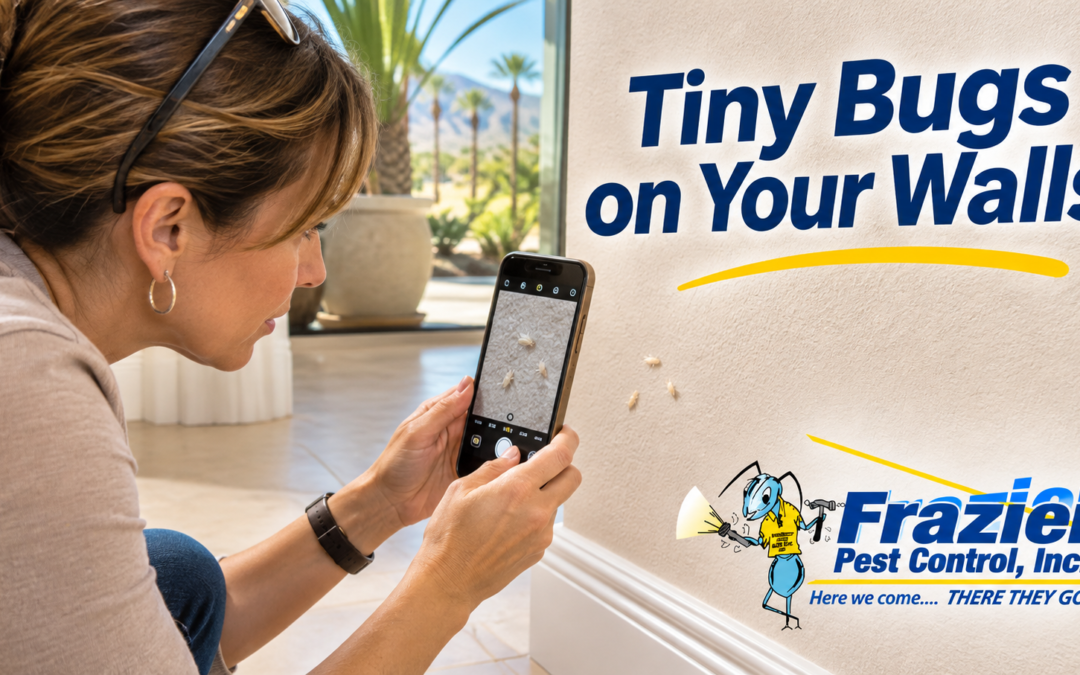
If you’re spotting tiny, pale, “rice-like” bugs on your walls in Palm Desert, the buyer question is usually: “What are these, and do I need treatment right now?” In most homes, that description points to a small group of common indoor pests—often booklice (psocids), carpet beetle larvae, or occasionally silverfish/firebrats—each with a different cause and a different fix. The fastest way to avoid wasted time (and wasted sprays) is to confirm what you’re actually seeing, then match the response to the conditions that allow that pest to show up.
The guidance below is meant to help you narrow it down and take the right next step. If you want a definitive ID and a plan that fits your home, Frazier Pest Control serves Palm Springs, Palm Desert, Rancho Mirage, Desert Hot Springs, Indian Wells, Cathedral City, La Quinta, Indio, and Coachella.
The fast answer: what “rice-like” bugs on walls usually are (and what they’re not)
When people say “rice-like” on walls, they’re usually describing one of these scenarios:
1) Booklice (psocids): These can look like tiny pale specks or grains moving slowly on walls, around window frames, or near baseboards. They’re often tied to moisture, humidity pockets, or mold/mildew growth you may not notice at first.
2) Carpet beetle larvae: Larvae can look like tiny, oval, fuzzy or bristly “seeds” and may be found crawling on walls as they wander away from a food source (lint, pet hair, stored fabrics, or dead insects in light fixtures/windowsills). Adults are small beetles; the larvae are the damaging stage for fabrics.
3) Silverfish or firebrats (young stages): These are more “carrot-shaped” than rice-shaped, but small juveniles can be mistaken for pale grains at a quick glance. They prefer hidden, humid areas and can show up near bathrooms, laundry areas, or kitchens.
What it usually is not: termite swarmers (those are winged and more obviously ant/termite-like), bed bugs (typically not described as rice-like on walls), or “eggs” stuck to the wall (most common household pests don’t lay eggs openly on painted walls in a way that looks like moving rice).
Quick ID checklist: size, movement, location, and what you’re seeing nearby
Use this checklist to get closer to an ID before you treat anything. If you can safely do so, capture one with clear tape or in a small container for a technician to identify.
1) Are they moving, or are they stuck in place?
If it’s moving, you’re dealing with an insect/larva. If it’s stuck and not moving, it may be debris, seed husks, or shed skins. Movement is the first divider.
2) What’s the movement style?
– Slow, wandering crawl on walls: often larvae (carpet beetle larvae are common) or booklice.
– Quick, darting movement when disturbed: more typical of silverfish/firebrats.
3) Where are you seeing them most?
– Bathrooms, laundry rooms, under sinks, around AC closets: points toward moisture-associated pests (booklice, silverfish/firebrats).
– Bedrooms/closets, near rugs, upholstered furniture, or along baseboards: points toward carpet beetle larvae or other fabric/organic debris feeders.
– Window sills, near lights, or around sliding doors: could indicate insects attracted to light that later become food for larvae, or entry points where small pests accumulate.
4) What else is nearby?
– Fine dust, lint, pet hair, or stored textiles: supports carpet beetle larvae.
– Musty odor, condensation, or signs of mildew: supports booklice or silverfish/firebrats.
– Dead bugs collecting in light fixtures or window tracks: can feed carpet beetle larvae indirectly.
What to check first in a desert home (humidity pockets, stored items, and entry points)
Even in the Coachella Valley, indoor “micro-climates” happen. Desert homes can have localized moisture that’s enough to support pests—especially when a home is closed up, the AC cycles irregularly, or plumbing/condensate issues create damp spots.
1) Hidden humidity pockets
Check these areas first:
– Under-sink cabinets (kitchen and bath)
– Behind toilets and around supply lines
– Laundry area (especially behind the washer)
– AC closet/air handler area and the condensate drain line area
– Garage corners where cardboard is stored against walls
Why it matters: booklice and silverfish/firebrats often track to moisture and the organic film/mildew that comes with it. If you treat insects but ignore the moisture source, activity can persist.
2) Stored paper, cardboard, and pantry-adjacent storage
Booklice can show up around stored goods, cardboard, and paper—especially if items were brought in already infested or were stored in a humid spot. In garages and closets, cardboard boxes against walls can create sheltered harborage.
3) Closets, baseboards, and “quiet” rooms
Carpet beetle larvae often develop where lint, hair, and natural fibers accumulate: under beds, along closet edges, in rarely-vacuumed corners, inside HVAC returns, or in stored blankets and seasonal clothing.
4) Entry points that look “too small to matter”
Small gaps around:
– Door sweeps and sliding door tracks
– Window frames
– Utility penetrations under sinks
– Garage door edges
These don’t always cause the problem (many of these pests originate indoors), but they can contribute to ongoing sightings and make it harder to tell whether you’re dealing with an indoor source or a steady trickle from outside.
What to do right now: safe cleanup, monitoring, and prevention steps
If you want to reduce sightings immediately while you figure out the cause, focus on steps that help regardless of the exact pest.
1) Do a targeted vacuum and disposal routine
– Vacuum baseboards, corners, closet edges, under furniture, and window tracks.
– Immediately empty the vacuum canister into a sealed bag and take it outside.
Why: This removes larvae, shed skins, and food sources (lint, hair, dead insects). It’s one of the highest-impact steps for carpet beetle larvae in particular.
2) Reduce moisture where you can
– Fix obvious leaks.
– Run bathroom exhaust fans during and after showers.
– Avoid storing cardboard directly on garage floors or against walls.
If you suspect an AC condensate issue (standing water, damp drywall, musty smell near the air handler), that’s a “solve the source” priority. Pest activity tied to moisture often improves once the damp condition is corrected.
3) Inspect and isolate suspect items
For closets and stored textiles:
– Wash/dry items on appropriate settings.
– Store cleaned items in sealed bins rather than cardboard.
For pantry-adjacent storage:
– Discard questionable dry goods if you see contamination.
– Wipe shelves and store new items in sealed containers.
4) Use monitoring instead of guessing with sprays
If you’re unsure what you’re seeing, avoid broad, repeated indoor spraying. Over-the-counter products can scatter some pests, contaminate living areas, or simply miss the real source.
Instead:
– Capture a specimen for ID.
– Note where you saw it (room, wall, height, time of day).
– Track whether sightings cluster near moisture, closets, or windows.
This information makes a professional visit faster and more accurate.
When to call a pro (and what a targeted service visit should clarify)
Call for help when any of these are true:
1) You’re seeing them daily or in multiple rooms
That pattern suggests either a widespread indoor source (stored items, lint/fiber sources, moisture pockets) or conditions that are supporting ongoing activity.
2) You can’t identify the pest confidently
Correct identification is the difference between:
– moisture correction + targeted treatment (often for booklice/silverfish/firebrats), and
– source removal + fabric/storage strategy + targeted treatment (often for carpet beetle larvae).
3) You’re finding damage or contamination
Examples include holes in natural-fiber clothing, damaged stored linens, or recurring insects in pantry-adjacent areas.
4) The home is seasonal or frequently closed up
Closed homes can develop unnoticed moisture issues and “quiet-zone” buildup (lint, dead insects in window tracks, etc.). A professional inspection can help determine whether the issue is primarily environmental (moisture/harborage) or primarily pest-driven.
What a targeted pest control visit should clarify
A good service call should aim to answer:
– What is the pest (adult vs. larva matters)?
– Where is it developing (source area), not just where it’s being seen?
– What conditions are supporting it (moisture, storage, entry points, sanitation/harborage)?
– What is the plan: source reduction steps you can do, plus targeted treatment where appropriate?
If you’re in Palm Desert or elsewhere in the Coachella Valley and you’re tired of guessing, Frazier Pest Control can help you identify the “rice-like” bugs on your walls and build a plan that addresses both the pest and the conditions that allow it to persist.
Next step: If you can, take a close-up photo and note the room and exact location (near a bathroom, closet, window, or AC area). That small bit of information often shortens the path to the correct fix.
If you’re seeing rice-like bugs on your walls and want a clear identification and targeted plan (not guesswork), contact Frazier Pest Control to schedule an inspection and service across the Coachella Valley.
Recent Comments